TelescopesComparison
Celestron NexStar 4SE, 6SE and 8SE vs StarSense Explorer Compared
NexStar 4SE, 6SE and 8SE against the StarSense Explorer DX 130AZ: aperture, focal length, mount, alignment, power and weight from Celestron's own pages.
We earn from qualifying purchases through links on this page. How we make money.
On this page
Choose a NexStar SE for a motorized mount that finds and then follows objects from a hand controller: Celestron lists the 4SE at 23 lb, the 6SE at 28 lb and the 8SE at 32 lb. Choose a StarSense Explorer for a lighter, battery-free telescope that you push by hand while a phone app points the way.
Sun safety
Never point a telescope, binoculars, a finder scope or a camera at the Sun without a special-purpose solar filter secured over the front of the optics. NASA says viewing the Sun through unfiltered optics “will instantly cause severe eye injury”, and that eclipse glasses must never be used with a telescope, binoculars or a camera. The American Astronomical Society adds that a finder scope must be capped, removed or filtered too, and that solar filters made to thread into an eyepiece are dangerous.
NexStar SE and StarSense Explorer specs side by side
Every figure below comes from the specification list on Celestron’s own product page for that model.
| Spec | NexStar 4SE | NexStar 6SE | NexStar 8SE | StarSense Explorer DX 130AZ |
|---|---|---|---|---|
| Optical design | Maksutov-Cassegrain | Schmidt-Cassegrain | Schmidt-Cassegrain | Newtonian reflector |
| Aperture | 102 mm (4.02 in) | 150 mm (5.91 in) | 203.2 mm (8 in) | 130 mm (5.11 in) |
| Focal length | 1325 mm | 1500 mm | 2032 mm | 650 mm |
| Focal ratio | f/13 | f/10 | f/10 | f/5 |
| Mount | Computerized alt-azimuth, single fork arm | Computerized alt-azimuth, single fork arm | Computerized alt-azimuth, single fork arm | Manual alt-azimuth with slow-motion controls |
| Alignment | SkyAlign and five other hand-controller methods | SkyAlign and five other hand-controller methods | SkyAlign and five other hand-controller methods | StarSense Explorer phone app |
| Power | 8 AA or 12 VDC, 750 mA | 8 AA or 12 VDC, 750 mA | 8 AA or 12 VDC, 750 mA | None required |
| Optical tube weight | 6 lb | 8 lb | 12 lb | Not stated by maker |
| Total kit weight | 23 lb | 28 lb | 32 lb | 18 lb |
| Included eyepieces | 25 mm (53x) | 25 mm (60x) | 25 mm (81x) | 25 mm (26x) and 10 mm (65x) |
Besides SkyAlign, Celestron lists 1-Star Align, 2-Star Align, Auto 2-Star Align, Solar System Align and an equatorial (EQ North and EQ South) alignment for all three SE models.
How is hand-controller GoTo different from StarSense app pointing?
The two systems answer the same question (where is that object?) in different ways.
NexStar SE: the mount does the moving
A NexStar SE sits on a motorized fork arm run from the NexStar+ hand control. You align it first. With SkyAlign, Celestron’s instruction is to “center three bright objects in your eyepiece and press ALIGN”, and its 6SE page says those objects can be stars, bright planets or the Moon.
After that, you pick a target from the hand control’s database, which Celestron puts at 40,000 objects on the 8SE page. The mount slews to it. Celestron says the SE has the pointing and tracking accuracy “to observe and follow your favorite targets”, so the object stays in the eyepiece while you look. A Sky Tour option lists the best objects visible at that moment.
The cost is power. None of this works without 8 AA batteries or a 12 VDC supply, and the product pages do not state how long a set of AA cells lasts.
StarSense Explorer: the phone does the finding
The StarSense Explorer DX 130AZ has no motors. Celestron describes a “manual altazimuth mount” with slow-motion controls on both axes, and lists its power requirement as none.
The phone sits in a dock on the telescope. Celestron says the app uses the phone to work out where the telescope is pointed, matching star patterns with a “Lost in Space Algorithm” of the kind satellites use to orient themselves. The app builds a list of objects visible that night. Pick one, and arrows appear on screen; you push the tube until the bullseye turns green.
Nothing follows the object for you afterward. As the sky turns, you nudge the slow-motion controls to keep the target in view. You also need a phone the app supports: Celestron’s page listed Android 12 or later and iOS 18 or later (iPhone XR and newer) on September 30, 2026.
The short version
On a NexStar SE, motors move the telescope to the target and keep following it, and they need power. On a StarSense Explorer, your phone shows where to push the tube, and you do the pushing and the following by hand.
NexStar 8SE vs 6SE: weight and targets
These two share an optical design, a focal ratio and the same mount type, so the choice comes down to aperture against weight.
- Light. Celestron rates the 6SE at 459 times the light gathering of the unaided eye and the 8SE at 843 times. Its limiting stellar magnitude figures are 13.4 for the 6SE and 14 for the 8SE.
- Magnification. Celestron lists a highest useful magnification of 354x for the 6SE and 480x for the 8SE. The same 25 mm eyepiece gives 60x on the 6SE and 81x on the 8SE, because the 8SE’s focal length is longer.
- Weight. The 8SE tube weighs 12 lb against 8 lb for the 6SE. Both use a 9 lb tripod, and the full kits come to 32 lb and 28 lb.
On the 8SE page, Celestron names Cassini’s Division in Saturn’s rings, the cloud bands on Jupiter, the spiral arms of the Whirlpool Galaxy and the stars of globular clusters as targets. The 6SE shows the same classes of object with a little over half the light, by Celestron’s own figures.
Four pounds does not sound like much. It sits in the optical tube, though, which is the part you lift onto the fork arm in the dark. Celestron says the SE “breaks down into several lightweight and compact pieces” for transport, so neither kit has to be carried in one trip.
Where does the NexStar 4SE fit?
The 4SE is a different optical design: a 102 mm Maksutov-Cassegrain at f/13. It is the lightest SE, with a 6 lb tube and a 23 lb kit.
Celestron gives it 212 times the light gathering of the eye and a limiting magnitude of 12.5, both well below the 6SE. The long focal ratio suits small, bright targets such as the Moon and planets more than wide, faint ones. Two features are particular to this model on Celestron’s page: an internal flip mirror for straight-through or 90 degree viewing, and a built-in wedge.
For how Maksutov, Schmidt-Cassegrain and Newtonian designs differ in general, see refractor vs reflector vs Schmidt-Cassegrain.
Celestron NexStar SE and StarSense Explorer telescopes on eBay
Shop the range
Browse current GoTo and app-guided telescopes on eBay.
Shop GoTo and app-guided telescopesOpens eBay in a new tab. Check condition, seller feedback and returns on the listing.
Current eBay listings for GoTo and app-guided telescopes, shown by eBay
Which one for which observer?
Balcony or small car, Moon and planets first: the 4SE, for its weight.
One telescope for planets and brighter deep-sky objects, carried by one person: the 6SE.
The most light in the SE line, with a heavier tube to lift: the 8SE.
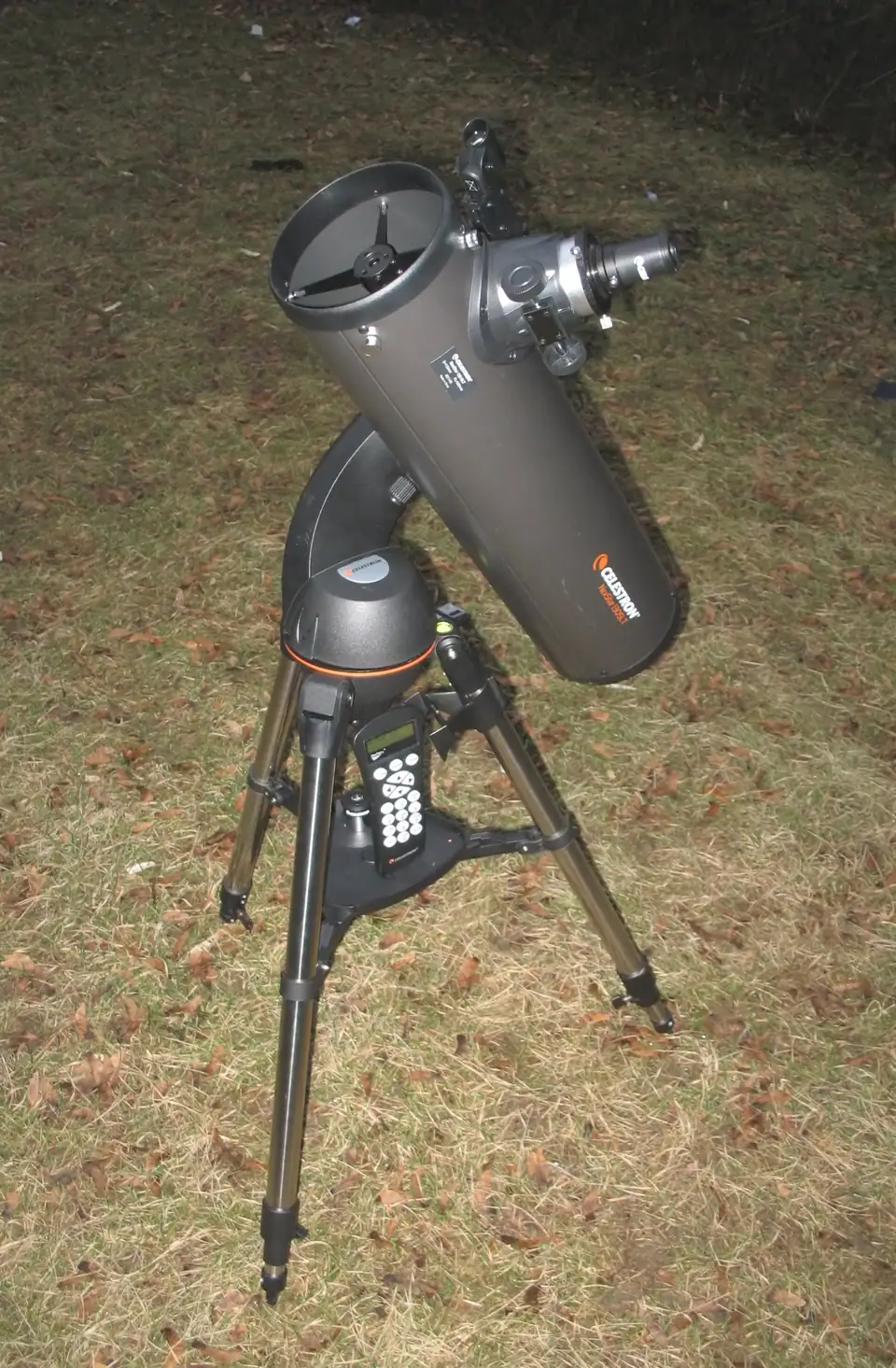
No batteries, a wide f/5 field, and you like finding things yourself with help: the StarSense Explorer DX 130AZ. At 650 mm of focal length it frames far more sky at 26x than any SE does with its supplied eyepiece.
If what you want is pictures on a phone instead of a view through glass, that is a separate category. The smart telescope comparison covers it, including Celestron’s own Origin.
What to add after buying
Each SE ships with a single 25 mm eyepiece and a StarPointer red dot finder. A second eyepiece is the usual first addition, and the eyepieces, Barlows and filters guide explains the magnification math.
Dew is the other practical matter for the two Schmidt-Cassegrains. Celestron’s knowledge base says condensation can form on a corrector plate “in a matter of minutes” in humid conditions, and that a dew shield slows the heat loss that causes it.
Buying secondhand? A computerized mount adds things to check that a manual telescope does not have: the hand control, the motors, the battery compartment. The used telescope checklist goes through them. For the rest of a first kit, start at the stargazing gear overview.
Frequently asked questions
What is the difference between NexStar SE and StarSense Explorer?
A NexStar SE has a motorized mount and a hand controller: after alignment it slews to the object you pick and follows it. Celestron describes the StarSense Explorer DX 130AZ mount as manual, with a phone app that shows arrows while you move the telescope yourself.
Is the NexStar 8SE too heavy for a beginner?
Celestron lists the full 8SE kit at 32 lb, with a 12 lb optical tube and a 9 lb tripod. The maker says the SE breaks down into several pieces for transport, so the heaviest single lift is less than the total.
How does SkyAlign work?
Celestron's instruction is to center three bright objects in the eyepiece and press ALIGN. The 6SE page says the objects can be stars, bright planets or the Moon, so you do not need to know their names first.
Does a NexStar SE need batteries?
Yes, it needs power to align, slew or track. Celestron lists 8 AA batteries or a 12 VDC, 750 mA tip-positive supply for the 4SE, 6SE and 8SE.
Does the StarSense Explorer track objects?
No. Celestron lists the DX 130AZ mount as a manual alt-azimuth with slow-motion controls on both axes and no power requirement, so you follow an object by hand as the sky turns.
Which phones work with StarSense Explorer?
On September 30, 2026, Celestron's DX 130AZ page listed Android 12 or later and iOS 18 or later (iPhone XR and newer). Check the current list on Celestron's page before buying, since phone requirements change with app updates.
Sources
- NexStar 4SE Computerized Telescope (specifications)Celestron
- NexStar 6SE Computerized Telescope (specifications)Celestron
- NexStar 8SE Computerized Telescope (specifications)Celestron
- StarSense Explorer DX 130AZ Smartphone App-Enabled Telescope (specifications)Celestron
- Telescope Dew Shields: Your Key to Crystal-Clear ViewsCelestron
- Eclipse Viewing SafetyNASA
- Solar Filters for Optics: Telescopes, Binoculars & CamerasAmerican Astronomical Society
Filed under TelescopesStart here: Stargazing Gear for Beginners: What to Buy First, and in What Order
Next rungs on the ladder
Start here
Stargazing Gear for Beginners: What to Buy First, and in What Order
A beginner's path through stargazing gear: eyes and a chart, binoculars, a first telescope, then upgrades and smart telescopes, with sourced specs.
Roundup
Telescopes for Beginners: What to Buy First, by Budget and Sky
How to choose a first telescope by budget band and by sky: aperture explained, what each size shows according to NASA, and maker weights to check.
Buying guide
Buying a Used Telescope: What to Check, Fair Makers and Red Flags
A checklist for buying a used telescope: optics, mirror coatings, mount, missing parts, shipping damage, eBay condition terms and the status of Meade and Orion.
Buying guide
Dobsonian Telescopes: 6-Inch vs 8-Inch and What You Will See
How a Dobsonian works, 6-inch vs 8-inch by maker specs for size and weight, tabletop models, collimation basics and what each aperture shows.