TelescopesComparison
Refractor vs Reflector vs Schmidt-Cassegrain: Telescope Types
Refractor, Newtonian reflector, Schmidt-Cassegrain and Maksutov compared in one table: focal ratio, upkeep, dew, portability and best targets, with sources.
We earn from qualifying purchases through links on this page. How we make money.
On this page
Choose a refractor if you want a low-maintenance telescope for the Moon, planets and double stars, and a Newtonian reflector if you want the most aperture for faint objects at a lower cost. Choose a Schmidt-Cassegrain or Maksutov-Cassegrain if a short, portable tube matters most and you can manage dew on the front corrector.
Sun safety
Never point a telescope, binoculars, a finder scope or a camera at the Sun without a special-purpose solar filter secured over the front of the optics. NASA says viewing the Sun through unfiltered optics “will instantly cause severe eye injury”, and that eclipse glasses must never be used with a telescope, binoculars or a camera. The American Astronomical Society adds that a finder scope must be capped, removed or filtered too, and that solar filters made to thread into an eyepiece are dangerous.
Telescope types compared in one table
The rows below come from Celestron’s knowledge-base guide to optical tubes unless another source is named. The example row uses Celestron’s and Sky-Watcher’s own specification pages.
| Attribute | Refractor | Newtonian reflector | Schmidt-Cassegrain | Maksutov-Cassegrain |
|---|---|---|---|---|
| How it gathers light | Lens at the front; light runs straight to the eyepiece at the back | Concave mirror at the back, flat secondary mirror, eyepiece on the side | Corrector plate, spherical primary and a secondary mirror | Heavier corrector lens, spherical primary and a secondary spot; light crosses the tube three times |
| Focal ratio (Celestron) | f/5 to f/15 | f/4 to f/8 | f/10 | f/13 to f/15 |
| Example (maker spec) | 102 mm, 660 mm, f/6.5 (StarSense Explorer DX 102AZ) | 130 mm, 650 mm, f/5 (StarSense Explorer DX 130AZ) | 203.2 mm, 2032 mm, f/10 (NexStar 8SE) | 102 mm, 1325 mm, f/13 (NexStar 4SE) |
| Collimation | None: the lens is permanently mounted and aligned | Regular at f/6 and lower | Simple checks, mostly after transport | Factory aligned; not needed often |
| Dew and cool-down | Dew can form on the front lens in humid air (Celestron dew shield guide) | Open tube; a larger mirror needs longer to cool (Sky-Watcher manual) | Corrector plate collects dew; a dew shield is recommended | Corrector collects dew and takes much longer to cool |
| Portability | Heavier, longer and bulkier than the others at equal aperture | Reasonably portable; bulky and heavy at 10 inches and up | Very compact for its aperture | Very short tube |
| Best targets | Moon, planets, double stars | Deep-sky objects, plus Moon and planets | All-purpose | High-resolution Moon and planets |
Refractor telescopes
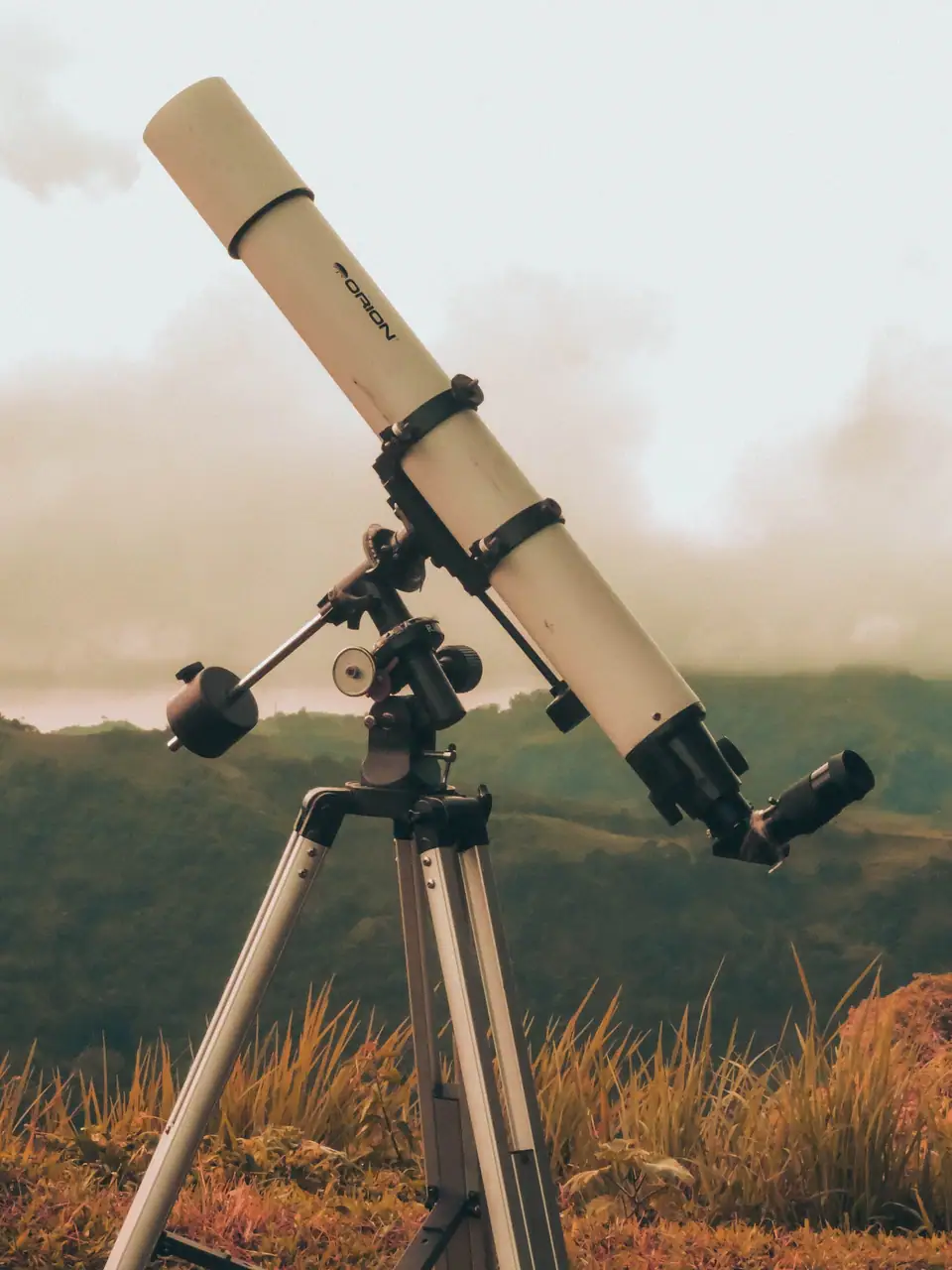
A refractor is the classic long tube with a lens at the front. Celestron describes it as easy to use and reliable because the design is simple, with high-contrast images since no secondary mirror blocks the light path.
The cost is aperture. Celestron says refractors cost much more per inch of aperture than reflectors or compound designs, and that size and expense limit how large they get. NASA’s Night Sky Network makes the same point: refractors “tend to be larger and more expensive than similarly powerful reflectors”.
Achromat or apochromat?
A simple lens bends colors by different amounts. The British Astronomical Association explains that red and blue light reach focus at slightly different points, so bright objects pick up a colored halo. This is chromatic aberration.
An achromat pairs two lens elements to reduce the halo. An apochromat (often shortened to “apo”) uses special glass such as fluorite to bring the colors almost together, and the BAA notes it costs a great deal more. For looking at the Moon through an eyepiece, an achromat is a sensible start.
How big is a 4-inch refractor?
Celestron’s StarSense Explorer DX 102AZ is a 102 mm f/6.5 refractor with a 660 mm focal length. Its tube is 32 inches long and weighs 5 lb, and the full kit with mount and tripod is 14.2 lb.
Refractor telescopes: achromats and apochromats
Shop the range
Browse current refractor telescopes on eBay.
Shop refractor telescopesOpens eBay in a new tab. Check condition, seller feedback and returns on the listing.
Current eBay listings for refractor telescopes, shown by eBay
Newtonian reflector telescopes
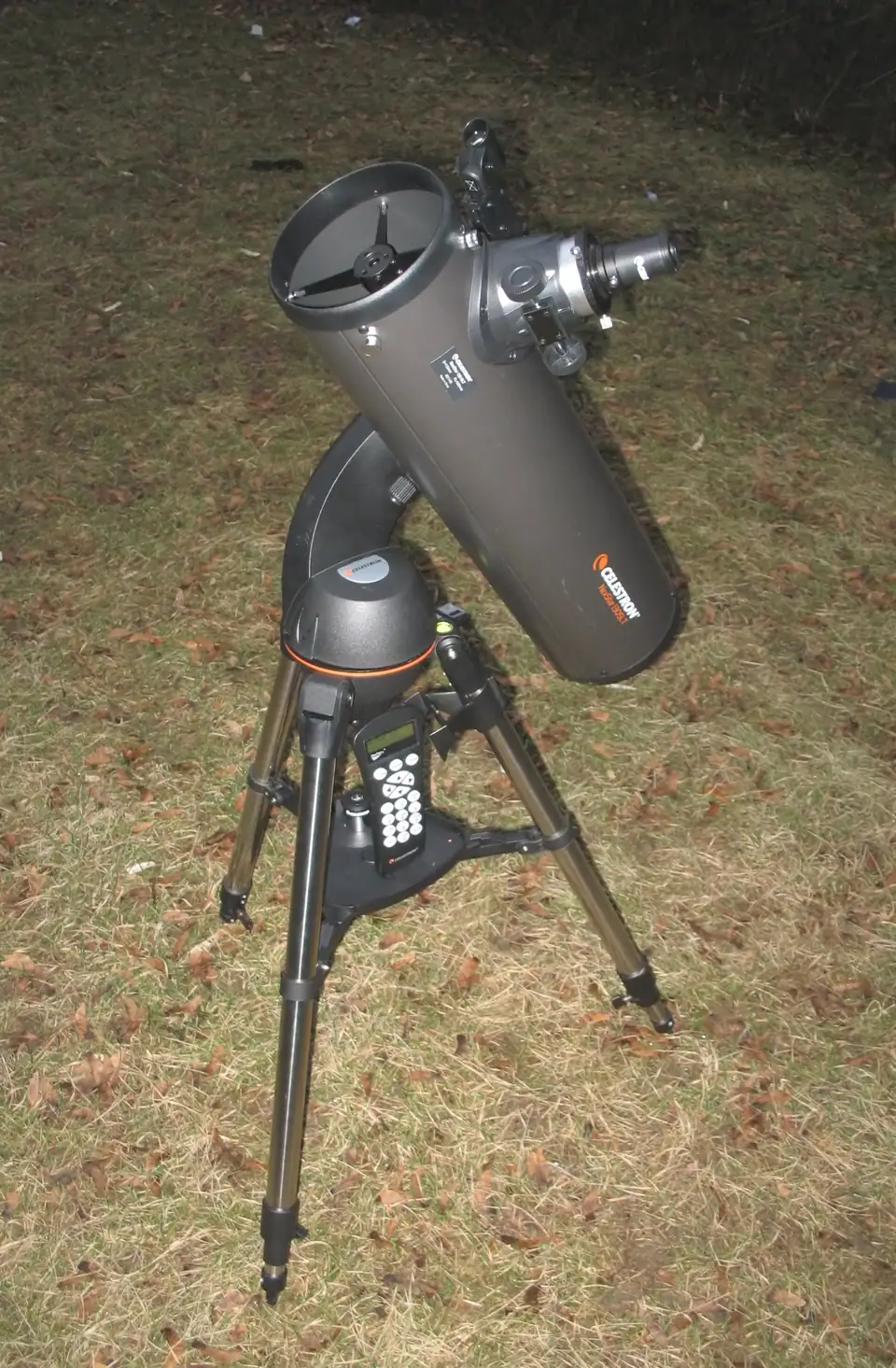
A Newtonian swaps the lens for a mirror. The BAA gives two reasons this matters: mirrors reflect all colors the same way, so there is no chromatic aberration, and a large mirror is cheaper to make than a large lens. In its words, “a 150mm Newtonian will be cheaper than a 150mm refractor”.
That is why reflectors lead on aperture for the money. Celestron’s 130 mm StarSense Explorer DX 130AZ has a 25-inch tube weighing 8.8 lb. Put a Newtonian on a simple rocker base and it becomes a Dobsonian; Sky-Watcher’s 8-inch model has a 203 mm mirror in a tube 112 cm long. The Dobsonian guide compares the 6-inch and 8-inch sizes.
The trade-offs, from Celestron’s guide:
- The secondary mirror and its supports sit in the light path, which adds diffraction spikes around bright stars.
- Models at f/6 and lower show coma, a stretching of stars near the edge of the view.
- Fast models need regular collimation. Sky-Watcher’s manual describes the star check: defocus a star slightly and see whether the rings are even.
- The view is inverted, so a Newtonian is a poor fit for daytime land viewing.
Newtonian reflectors on Dobsonian bases
Shop the range
Browse current dobsonian telescopes on eBay.
Shop dobsonian telescopesOpens eBay in a new tab. Check condition, seller feedback and returns on the listing.
Current eBay listings for dobsonian telescopes, shown by eBay
Schmidt-Cassegrain and Maksutov-Cassegrain telescopes
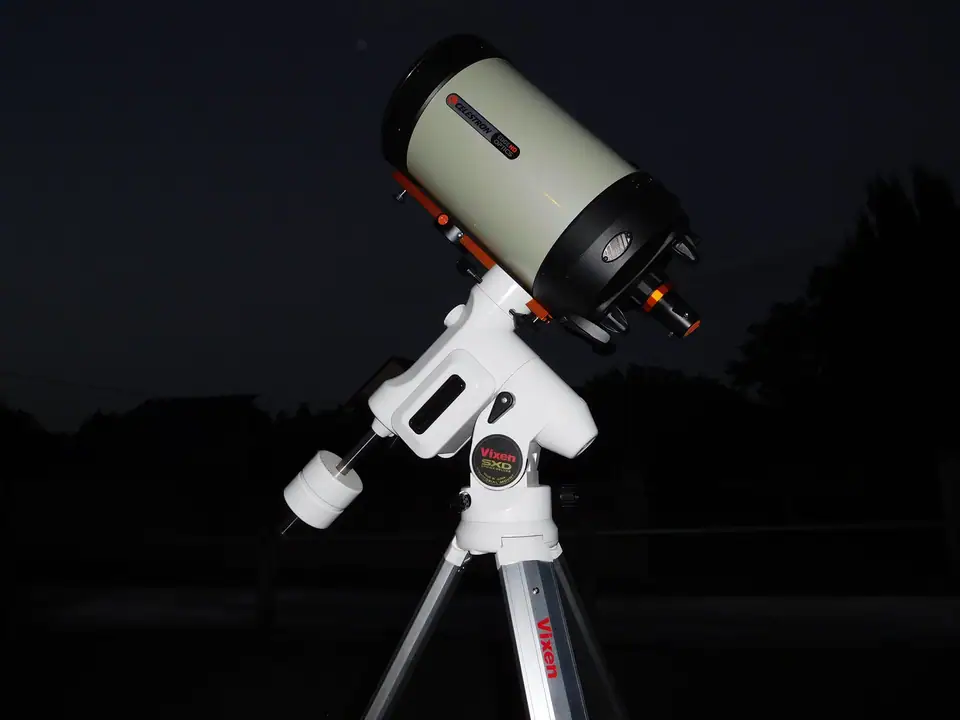
Both are compound (catadioptric) designs: mirrors do the focusing and a glass corrector at the front fixes the image. Folding the light path is the point. Celestron’s NexStar 8SE packs a 2032 mm focal length into a tube 17 inches long that weighs 12 lb. An 8-inch Dobsonian tube from Sky-Watcher is 112 cm long and 11 kg.
Schmidt-Cassegrain (SCT)
Celestron calls the SCT its best all-purpose design and notes that more accessories exist for it than for other types. The BAA adds that the closed tube protects the optics, and that SCTs are expensive, more so with computerized mounts.
Celestron’s listed drawbacks: the secondary mirror costs some contrast compared with a refractor, the corrector plate is subject to dew, and collimation is worth checking after transport. Its dew shield guide says condensation can form on a corrector plate “in a matter of minutes” in humid conditions. A dew shield slows the cooling of the glass and keeps damp air away.
Maksutov-Cassegrain (Mak)
A Mak uses a larger, heavier corrector lens. Celestron lists focal ratios of f/13 to f/15, factory-aligned optics that seldom need collimation, and a smaller secondary obstruction than Newtonians or SCTs. It recommends the design for high-resolution lunar and planetary viewing.
The weak points are a narrow field of view and the corrector itself, which Celestron says “takes much longer to cool down” and collects dew.
Size is the draw. Celestron’s NexStar 4SE is a 102 mm Mak with a 1325 mm focal length in a 343 mm tube (about 13.5 inches) weighing 6 lb. The 102 mm refractor above needs 32 inches.
Both NexStar models ride on computerized GoTo mounts. The NexStar and StarSense comparison covers the mounts and alignment.
Schmidt-Cassegrain and Maksutov GoTo telescopes
Shop the range
Browse current GoTo and app-guided telescopes on eBay.
Shop GoTo and app-guided telescopesOpens eBay in a new tab. Check condition, seller feedback and returns on the listing.
Current eBay listings for GoTo and app-guided telescopes, shown by eBay
Which telescope type should you buy?
Match the design to where and how you will observe.
- You want to see faint galaxies and nebulae and have storage space: a Newtonian on a Dobsonian base. It is the design NASA’s Night Sky Network recommends for a first telescope, in the 4.5 to 8 inch range.
- You want something to grab for ten minutes on the Moon with no adjustments: a small refractor. Nothing to collimate.
- You live in an apartment or travel with the telescope: a Maksutov for the Moon and planets, or a Schmidt-Cassegrain if you also want aperture for deep-sky objects. Budget for a dew shield.
- You expect to try astrophotography later: Celestron lists the SCT as suited to it. A hand-pushed Dobsonian is not, since the base does not track.
Aperture still decides how much any of them shows. The beginner telescope guide sorts specific sizes by budget and sky, and the stargazing gear overview sets out what to buy first.
Frequently asked questions
Is a refractor or a reflector better for a beginner?
Both work. NASA's Night Sky Network points first-time buyers to a small reflector on a tabletop or Dobsonian mount, with a 4.5 to 8 inch mirror, and notes that refractors need little maintenance but cost more for similar power. Pick the reflector for aperture and the refractor for low upkeep.
What is the difference between a refractor and a reflector telescope?
A refractor gathers light with a lens at the front of the tube, and a reflector gathers it with a mirror at the back. Celestron says the refractor's lens is permanently aligned, while fast Newtonian reflectors need their mirrors collimated regularly.
What is a Schmidt-Cassegrain telescope good for?
Celestron calls it the best all-purpose design, suited to deep-sky, lunar and planetary viewing and to astrophotography. It folds a long focal length into a short tube: the 8-inch NexStar 8SE has a 2032 mm focal length in a 17-inch tube.
Do refractors need collimation?
Not in normal use. Celestron says a refractor's objective lens is permanently mounted and aligned, which is why it lists minimal upkeep as one of the design's advantages.
Why do refractors show color fringes around bright objects?
The British Astronomical Association explains that a lens brings red and blue light to focus at slightly different points, which is called chromatic aberration. Achromatic lenses reduce it, and apochromatic refractors come close to removing it at a much higher cost.
Is a Maksutov the same as a Schmidt-Cassegrain?
They are related compound designs that use mirrors and a front corrector. Celestron lists Maksutovs at f/13 to f/15 with a thicker corrector lens that cools slowly, and Schmidt-Cassegrains at f/10 as more of an all-rounder.
Sources
- Eclipse Viewing SafetyNASA
- Solar Filters for Optics: Telescopes, Binoculars & CamerasAmerican Astronomical Society
- The Ultimate Guide to Celestron Optical TubesCelestron
- Common types of telescopeBritish Astronomical Association
- How to Choose a First TelescopeNASA Night Sky Network
- Telescope Dew Shields: Your Key to Crystal-Clear ViewsCelestron
- StarSense Explorer DX 102AZ (specifications)Celestron
- StarSense Explorer DX 130AZ (specifications)Celestron
- NexStar 4SE Computerized Telescope (specifications)Celestron
- NexStar 8SE Computerized Telescope (specifications)Celestron
- DOB 8" Traditional (specifications)Sky-Watcher
- Dobsonians instruction manual (150mm, 200mm, 254mm)Sky-Watcher
Filed under TelescopesStart here: Stargazing Gear for Beginners: What to Buy First, and in What Order
Next rungs on the ladder
Start here
Stargazing Gear for Beginners: What to Buy First, and in What Order
A beginner's path through stargazing gear: eyes and a chart, binoculars, a first telescope, then upgrades and smart telescopes, with sourced specs.
Roundup
Telescopes for Beginners: What to Buy First, by Budget and Sky
How to choose a first telescope by budget band and by sky: aperture explained, what each size shows according to NASA, and maker weights to check.
Buying guide
Buying a Used Telescope: What to Check, Fair Makers and Red Flags
A checklist for buying a used telescope: optics, mirror coatings, mount, missing parts, shipping damage, eBay condition terms and the status of Meade and Orion.
Comparison
Celestron NexStar 4SE, 6SE and 8SE vs StarSense Explorer Compared
NexStar 4SE, 6SE and 8SE against the StarSense Explorer DX 130AZ: aperture, focal length, mount, alignment, power and weight from Celestron's own pages.