TelescopesRoundup
Telescopes for Beginners: What to Buy First, by Budget and Sky
How to choose a first telescope by budget band and by sky: aperture explained, what each size shows according to NASA, and maker weights to check.
We earn from qualifying purchases through links on this page. How we make money.
On this page
Buy the largest aperture you will carry outside on a weeknight, on a mount that does not wobble. For most beginners that means a 6 or 8-inch Dobsonian if there is a yard or a car, or a 70 to 130 mm telescope for a balcony. Ignore the magnification printed on the box.
Sun safety
Never point a telescope, binoculars, a finder scope or a camera at the Sun without a special-purpose solar filter secured over the front of the optics. NASA says viewing the Sun through unfiltered optics “will instantly cause severe eye injury”, and that eclipse glasses must never be used with a telescope, binoculars or a camera. The American Astronomical Society adds that a finder scope must be capped, removed or filtered too, and that solar filters made to thread into an eyepiece are dangerous.
What matters in a first telescope?
Three things, in this order.
Aperture. This is the diameter of the main lens or mirror. Astronomer Andrew Fraknoi’s 2025 buying guide calls it the key characteristic of a telescope: a larger aperture gathers more light and shows fainter objects. When someone says they own a 6-inch telescope, the 6 inches is the aperture.
The mount. Fraknoi’s guide says even the smallest vibration can move the object out of view, because a telescope shows a tiny, magnified patch of sky. The Smithsonian National Air and Space Museum’s buying tips say to find a solid mount before paying for electronics.
Whether you will use it. The Smithsonian puts it this way: the right telescope is the one you will actually use. Weight and setup time decide that more than optics do.
Magnification is missing from the list on purpose. The Smithsonian’s advice is to stay away from any telescope advertised for its magnifying power.
Which telescope fits your budget and your sky?
Prices change week to week, so the bands below are described in words. Two facts from the sources set the pattern: Dobsonians give large diameters for relatively low prices (Smithsonian), and a refractor costs more than a reflector of the same aperture because both sides of a lens must be polished and the glass must be high quality throughout (Fraknoi).
| Budget band | City balcony or small patio | Yard, or a drive to a dark site |
|---|---|---|
| Lowest | Binoculars, 7x35 to 10x50, in place of a telescope | The same binoculars plus a planisphere |
| Entry | 70 to 80 mm refractor on a tripod | Tabletop reflector, 114 to 130 mm, on a sturdy table or stool |
| Middle | 130 mm reflector with app-guided pointing | 6-inch Dobsonian |
| Upper beginner | Small computerized (GoTo) telescope | 8-inch Dobsonian |
The balcony column favors small and quick. A balcony usually faces one slice of sky, and the targets that survive city light are the bright ones. NASA’s skywatching FAQ says light pollution washes out the fainter stars and the Milky Way, while binoculars or a small telescope still show Jupiter’s large moons and Saturn’s rings.
The dark-site column favors aperture, because faint galaxies and nebulae need light-gathering area and a dark background. If the telescope has to ride in a car, check the maker’s weight and tube length against your trunk before you buy.
For the lowest band, the Smithsonian and NASA’s Night Sky Network both point to binoculars as a first instrument. The binoculars for stargazing guide explains the sizes.
How heavy are beginner telescopes?
These figures come from the makers’ own specification pages.
| Telescope (maker page) | Type | Aperture | Focal length | Kit weight |
|---|---|---|---|---|
| Celestron AstroMaster 70AZ | Refractor on tripod | 70 mm | 900 mm | 10.8 lb |
| Celestron StarSense Explorer LT 80AZ | Refractor on tripod | 80 mm | 900 mm | 9.2 lb |
| Celestron StarSense Explorer 114mm Dobsonian | Tabletop reflector | 114 mm | 450 mm | 12.6 lb |
| Celestron StarSense Explorer DX 130AZ | Reflector on tripod | 130 mm | 650 mm | 18 lb |
| Celestron StarSense Explorer 8-inch Dobsonian | Floor-standing Dobsonian | 203 mm | 1200 mm | 43.4 lb |
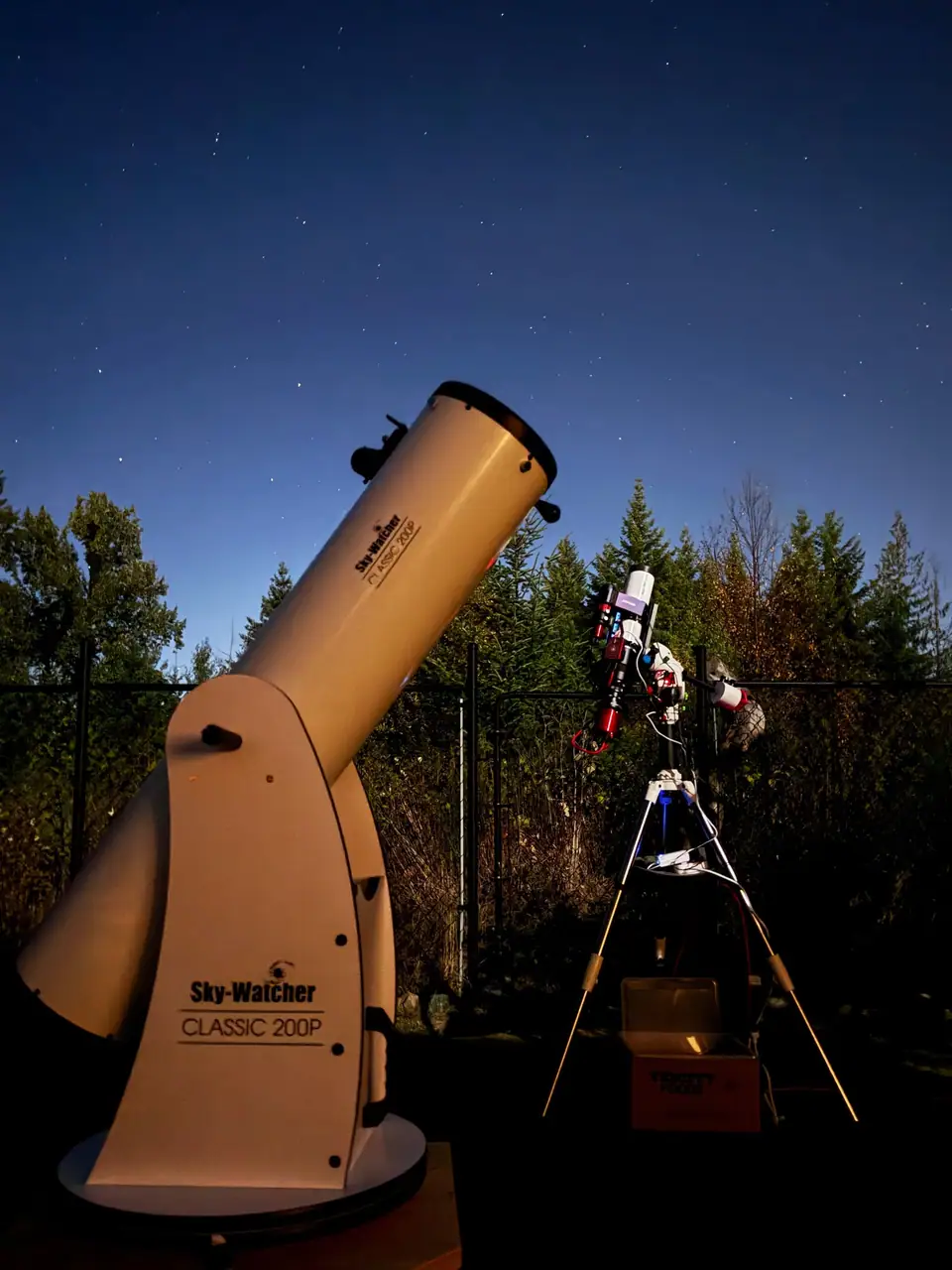
The 8-inch Dobsonian moves in two trips: Celestron lists the tube at 20.6 lb and 44 inches long, and the base at 22.8 lb. Sky-Watcher USA’s Heritage 130 is a 130 mm, 650 mm tabletop Dobsonian with a collapsible tube that the maker says keeps its collimation (mirror alignment) while packing smaller. Its Classic 150P is a 6-inch Dobsonian with a 2-inch focuser and a 6x30 finder scope.
Small refractors and tabletop reflectors for beginners
Shop the range
Browse current beginner telescopes on eBay.
Shop beginner telescopesOpens eBay in a new tab. Check condition, seller feedback and returns on the listing.
Current eBay listings for beginner telescopes, shown by eBay
What will you actually see?
Expect small, real views, not the color photographs on the box. The table gathers what NASA and the Astronomical League say each size of instrument reaches.
| Instrument | What sources say it shows | Source |
|---|---|---|
| Binoculars, 7x35 to 10x50 | The Moon, the Pleiades and, from dark skies, the Andromeda Galaxy and the Orion Nebula | NASA Night Sky Network |
| Binoculars or a small telescope | Jupiter’s four large moons in a line, Saturn’s rings, star clusters, double stars | NASA |
| About 3 inches (76 mm) | Every object in the Messier catalog, under good observing conditions | Astronomical League |
| 4 inches (about 100 mm) | Saturn’s moon Titan, even under urban and suburban skies | NASA Night Sky Notes, 2024 |
| 6 to 10 inches | The League’s recommended range for deep-sky objects from light-polluted cities | Astronomical League |
The Smithsonian suggests an order for first nights: the Moon when it is a crescent or half full, then the brighter planets (Jupiter, Saturn, Venus, Mars), then nebulae and star clusters.
How much magnification is enough?
Celestron’s knowledge base gives the arithmetic. Magnification equals the telescope’s focal length divided by the eyepiece’s focal length, and the usable maximum is 50 to 60 times the aperture in inches under ideal conditions. Above that, Celestron says, the image turns dim and low in contrast.
Celestron’s spec pages apply the rule to each model: 165x for the 70 mm AstroMaster, 189x for the 80 mm refractor, 307x for the 130 mm reflector and 480x for the 8-inch Dobsonian. Those are ceilings for perfect nights. Fraknoi’s guide explains why ordinary nights fall short: a telescope magnifies the turbulence of Earth’s atmosphere along with the target, so at too high a power the image shimmers.
Most observing happens well below the ceiling. Celestron says 6 to 25 times the aperture in inches gives brighter, crisper views. The eyepieces and filters guide covers how to choose eyepieces for that range.
Is it worth buying a cheap telescope?
The Smithsonian National Air and Space Museum’s answer is no for the very cheapest: its buying tips say most of them have low optical quality and are not worth it, and that binoculars are the better buy at that level.
There is a cheaper route to a good telescope, which is buying used. A plain Dobsonian has few parts to fail, and the used telescope guide lists what to check in a listing and at pickup.
Can you see planets with a cheap telescope?
Yes. NASA’s skywatching FAQ says binoculars or a small telescope make visible the large moons of Jupiter and the rings of Saturn. NASA’s Night Sky Notes for September 2024 adds that Jupiter’s four Galilean moons are the easiest to see with a small pair of binoculars or a small telescope because they form a clear line.
Steadiness counts as much as optics here. A shaky tripod makes a planet hard to hold in view at the powers where its detail shows, which is why the sources above rank the mount so highly.
Dobsonian, refractor or computerized?
A Dobsonian is a reflector on a simple rocking base that you push by hand. It has the most aperture in the beginner bands and no electronics. The Dobsonian telescope guide compares 6-inch and 8-inch models.
Dobsonian telescopes: tabletop, 6-inch and 8-inch
Shop the range
Browse current dobsonian telescopes on eBay.
Shop dobsonian telescopesOpens eBay in a new tab. Check condition, seller feedback and returns on the listing.
Current eBay listings for dobsonian telescopes, shown by eBay
A refractor uses a lens, has a sealed tube and needs little upkeep, at a higher cost per inch of aperture. The refractor vs reflector comparison sets out the trade-offs, including Schmidt-Cassegrain designs.
Pointing help comes in two forms. Celestron’s StarSense Explorer models use a phone in a dock: the app reads star patterns to work out where the telescope is aimed, after an alignment step that Celestron describes as a quick, 2-minute procedure. You still move the tube by hand. A GoTo telescope has motors and drives itself to the target.
Fraknoi suggests a computerized telescope for people who cannot yet identify most constellations. He also recommends trying telescopes at a local astronomy club’s public star party before spending anything.
Buying for a child changes the sums, since the telescope has to be light enough for small hands and labeled for the right age. See telescopes for kids. For everything else in the kit bag, go back to the stargazing gear overview.
Frequently asked questions
What is a good telescope for a beginner?
One you will carry outside often. The Smithsonian National Air and Space Museum calls the Dobsonian a popular first telescope, with large diameters for relatively low prices and a base that is simple to point. A 70 to 80 mm refractor on a tripod is the lighter option.
Is it worth buying a cheap telescope?
The Smithsonian National Air and Space Museum's buying tips say most of the cheapest telescopes have low optical quality and are not worth it. Its advice for a small budget is a good pair of binoculars instead.
Can you see planets with a cheap telescope?
Yes, the bright ones. NASA's skywatching FAQ says binoculars or a small telescope make visible the large moons of Jupiter and the rings of Saturn. How sharp they look depends on the optics, a steady mount and steady air.
How much magnification does a beginner telescope need?
Less than the box suggests. Celestron puts the usable maximum at 50 to 60 times the aperture in inches under ideal conditions, and says most observing is done at 6 to 25 times the aperture in inches.
What size telescope do I need to see galaxies?
The Astronomical League says nothing in the Messier catalog is beyond a three-inch reflector under good observing conditions. From a light-polluted city it recommends 6 to 10 inches of aperture for its Urban Observing Program.
Should a beginner buy a computerized telescope?
Andrew Fraknoi's 2025 buying guide suggests one for people who cannot yet identify most constellations from their location. The Smithsonian's tips lean the other way on a tight budget: put the money into a solid mount before electronics.
Sources
- Eclipse Viewing SafetyNASA
- Solar Filters for Optics: Telescopes, Binoculars & CamerasAmerican Astronomical Society
- Tips for Telescope Buying (Shauna Edson, December 20, 2015)Smithsonian National Air and Space Museum
- A Buying Guide for a First Telescope (Andrew Fraknoi, 2025)Andrew Fraknoi
- Skywatching FAQNASA
- September's Night Sky Notes: Marvelous Moons (Kat Troche, August 30, 2024)NASA
- Binoculars: A Great First TelescopeNASA Night Sky Network
- Messier Observing ProgramAstronomical League
- Urban Observing ProgramAstronomical League
- What is magnification/power as it pertains to telescopes?Celestron
- AstroMaster 70AZ Telescope: specificationsCelestron
- StarSense Explorer LT 80AZ: specificationsCelestron
- StarSense Explorer 114mm Tabletop Dobsonian: specificationsCelestron
- StarSense Explorer DX 130AZ: specificationsCelestron
- StarSense Explorer 8-inch Dobsonian Telescope: specificationsCelestron
- Heritage 130 Tabletop DobsonianSky-Watcher USA
- Classic 150P DobsonianSky-Watcher USA
Filed under TelescopesStart here: Stargazing Gear for Beginners: What to Buy First, and in What Order
Next rungs on the ladder
Start here
Stargazing Gear for Beginners: What to Buy First, and in What Order
A beginner's path through stargazing gear: eyes and a chart, binoculars, a first telescope, then upgrades and smart telescopes, with sourced specs.
Buying guide
Buying a Used Telescope: What to Check, Fair Makers and Red Flags
A checklist for buying a used telescope: optics, mirror coatings, mount, missing parts, shipping damage, eBay condition terms and the status of Meade and Orion.
Comparison
Celestron NexStar 4SE, 6SE and 8SE vs StarSense Explorer Compared
NexStar 4SE, 6SE and 8SE against the StarSense Explorer DX 130AZ: aperture, focal length, mount, alignment, power and weight from Celestron's own pages.
Buying guide
Dobsonian Telescopes: 6-Inch vs 8-Inch and What You Will See
How a Dobsonian works, 6-inch vs 8-inch by maker specs for size and weight, tabletop models, collimation basics and what each aperture shows.