Smart telescopes and imagingComparison
Smart Telescopes Compared: Seestar, Dwarf 3, Vespera, Odyssey, Origin
Seestar S50 and S30, Dwarf 3, Vespera II, Unistellar Odyssey and Celestron Origin compared by aperture, sensor, field of view, weight and battery, with sources.
We earn from qualifying purchases through links on this page. How we make money.
On this page
A smart telescope is a small motorized telescope with a built-in camera that finds a target, stacks exposures and shows the picture on your phone. The Seestar S30 and Dwarf 3 are the lightest, the Seestar S50 and Vespera II sit in the middle, and the Unistellar Odyssey and Celestron Origin carry far larger optics.
Sun safety
Never point a telescope, binoculars, a finder scope or a camera at the Sun without a special-purpose solar filter secured over the front of the optics. NASA says viewing the Sun through unfiltered optics “will instantly cause severe eye injury”, and that eclipse glasses must never be used with a telescope, binoculars or a camera. The American Astronomical Society adds that a finder scope must be capped, removed or filtered too, and that solar filters made to thread into an eyepiece are dangerous.
Smart telescope specs compared
Five of the six columns use the maker’s own specification page. Dwarflab’s site could not be opened when this page was written, so the Dwarf 3 column uses the figures printed in the BBC Sky at Night Magazine and Astronomy magazine reviews.
| Spec | Seestar S50 | Seestar S30 | Dwarf 3 | Vespera II | Odyssey | Origin Mark II |
|---|---|---|---|---|---|---|
| Maker | ZWO | ZWO | Dwarflab | Vaonis | Unistellar | Celestron |
| Aperture | 50 mm | 30 mm | 35 mm | 50 mm | 85 mm | 152 mm |
| Focal length | 250 mm | 150 mm | 150 mm | 250 mm | 320 mm | 335 mm |
| Focal ratio | f/5 | f/5 | f/4.3 | f/5 | f/3.9 | f/2.2 |
| Optics | Triplet apochromat | Triplet apochromat | Telephoto plus wide-angle lens | Quadruplet apochromat | Mirror (design not stated by maker) | Rowe-Ackermann Schmidt Astrograph |
| Sensor | Sony IMX462 | Sony IMX662 (telephoto) | Sony IMX678 | Sony IMX585 | Not stated by maker | Sony IMX678 |
| Field of view | 0.73 x 1.29 degrees | 2.46 degrees telephoto, 23.2 degrees wide | Telephoto not stated in the cited reviews | 2.5 x 1.4 degrees | 33.6 x 45 arcminutes | 1.32 x 0.75 degrees |
| Weight | 2.5 kg | 1.65 kg | 1.3 kg | 5 kg | 4 kg | 41.6 lb (18.87 kg) with mount and tripod |
| Battery | 6,000 mAh, about 6 hours | 6,000 mAh, about 6 hours | 10,000 mAh | 4 hours | 5 hours | 97.9 Wh, 6+ hours |
| Mount | Alt-azimuth, equatorial mode supported | Alt-azimuth, equatorial mode supported | Equatorial mode supported | Not stated on the spec page; run from the Singularity app | Motorized alt-azimuth | Computerized GoTo alt-azimuth |
| Storage | 64 GB | 64 GB | 128 GB | 25 GB | 64 GB | Raw files through USB ports |
Two notes on reading it. ZWO gives one angle for each S30 camera instead of a width and height. Unistellar lists a pixel size (1.45 micrometers) for the Odyssey but no sensor model.
What does a smart telescope show, and what does it miss?
BBC Sky at Night Magazine’s guide to the category (Iain Todd, September 14, 2026) defines these instruments by two things: automated pointing, and a camera that keeps stacking frames in an app. The picture on the phone gets cleaner the longer the telescope stays on a target.
That is why they do well on faint galaxies and nebulae. The magazine says they are particularly effective on deep-sky objects and in light pollution. An eyepiece shows only the light arriving at that moment, while the camera keeps adding more.
The same guide lists the limits:
- Planets. Small apertures and short focal lengths make high-resolution planetary imaging hard. Astronomy magazine’s review of the Dwarf 3 (Phil Harrington, August 2025 issue) reached the same verdict for that model.
- No eyepiece. Most models show the sky only on a screen. Vaonis says the Vespera II has “only one button, no eyepiece”. Unistellar lists an eyepiece, developed with Nikon, on the Odyssey Pro only.
- Framing. Many cannot fit a large object such as the Andromeda Galaxy in one frame. Vaonis answers this with a mosaic mode it calls CovalENS, which widens the Vespera II’s field to 4.33 x 2.43 degrees.
- Cost. The magazine names price as a barrier for beginners.
So a smart telescope and an eyepiece telescope are different experiences. One produces a shared picture on a screen after some minutes. The other puts live light from Saturn or the Moon into your eye. If the second is what you are after, compare the NexStar SE and StarSense Explorer telescopes instead.
The short version
Pick a smart telescope for pictures of faint galaxies and nebulae that build up on a phone, including from a light-polluted yard. Pick an eyepiece telescope for live views of the Moon and planets.
The six models, one at a time
ZWO Seestar S50
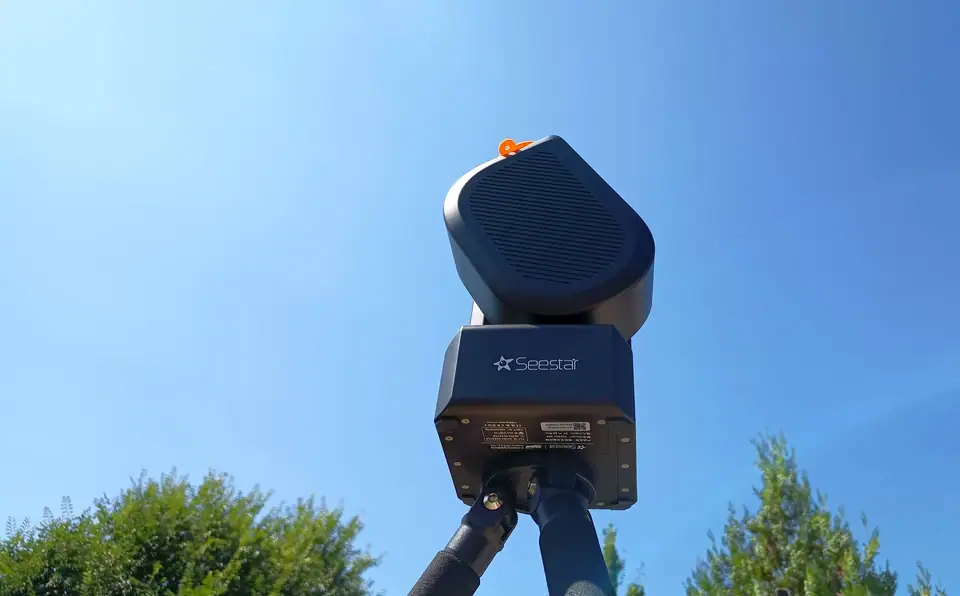
ZWO describes the S50 as a telescope, electric focuser, camera, alt-azimuth mount, dew heater and filter wheel in one 2.5 kg body. Its built-in filters are a UV/IR-cut filter and a duo-band (OIII and H-alpha) filter. The field of view, 0.73 x 1.29 degrees, is the narrowest of the small models here, which suits smaller targets and makes large ones a mosaic job.
ZWO Seestar S30
The S30 trades aperture for width and weight: 30 mm, a 2.46 degree telephoto field and 1.65 kg. It adds a second wide-angle camera with a 23.2 degree field. ZWO estimates about 6 hours of battery in stargazing mode and about 4 hours in scenery or video mode.
Dwarflab Dwarf 3
The Dwarf 3 is the lightest here at 1.3 kg, with two lenses and a Sony IMX678 sensor. BBC Sky at Night Magazine’s review (Sonia Turkington, April 15, 2025) reports a 10,000 mAh battery, 128 GB of storage, built-in filters and an equatorial mode that supports exposures up to 60 seconds. The reviewer noted that no tripod is included and that the wide-angle lens focus cannot be adjusted by hand.
Vaonis Vespera II
This comparison uses the Vespera II, not the Vespera Pro or later models. Vaonis lists a 50 mm quadruplet apochromat, a Sony IMX585 sensor at 3840 x 2160 pixels and a 2.5 x 1.4 degree native field. It weighs 5 kg and its stated battery life, 4 hours, is the shortest in the table.
Unistellar Odyssey
Unistellar lists an 85 mm mirror, a 320 mm focal length and a weight of 4 kg. The maker says no focus or collimation adjustment is needed, and gives a limiting magnitude of 17.2. Its field, 33.6 x 45 arcminutes, is a little over half a degree on the short side, so it is the most zoomed-in of the portable models.
Celestron Origin Mark II
The Origin is a different scale of instrument: a 152 mm f/2.2 Rowe-Ackermann Schmidt Astrograph on a GoTo mount and tripod, 41.6 lb in total. Celestron says it aligns itself with StarSense technology in under two minutes, and that built-in algorithms stack and process each frame. It has a filter drawer for 1.25 inch or 2 inch filters and an automated dew heater. Celestron calls it a home observatory, and the weight matches that description.
Smart telescopes on eBay: Seestar, Dwarf, Vespera, Unistellar and Origin
Shop the range
Browse current smart telescopes on eBay.
Shop smart telescopesOpens eBay in a new tab. Check condition, seller feedback and returns on the listing.
Current eBay listings for smart telescopes, shown by eBay
How to choose between them
Start with where it will be used. A 1.3 to 2.5 kg unit goes in a day bag; a 41.6 lb system lives near the door to the yard.
Then look at field of view against your targets. Wide fields (Seestar S30, Vespera II) frame large nebulae. Narrow fields (Seestar S50, Odyssey) suit smaller galaxies and clusters.
Battery and storage come last, since every model here lists at least 4 hours.
Where to go from here
A smart telescope is one of three routes into night sky photography. The beginner astrophotography gear guide sets it beside a camera on a star tracker.
Buying one as a present? The stargazing gifts guide matches gear to the person. For binoculars, first telescopes and everything else, return to the stargazing gear overview.
Frequently asked questions
Are smart telescopes any good?
For faint deep-sky objects, yes, by the account of BBC Sky at Night Magazine, which says they make observing and photographing the night sky close to a one-button job and cope well with light pollution. The same guide says small apertures and short focal lengths make high-resolution planet images hard.
Can you look through a smart telescope?
Usually not. Vaonis describes the Vespera II as having 'only one button, no eyepiece', and Celestron's Origin sends its images to a phone, tablet or TV. Unistellar lists an eyepiece on the Odyssey Pro only.
Can a smart telescope see planets?
Makers differ. Unistellar says the Odyssey shows Jupiter's Great Red Spot and Saturn's rings, while BBC Sky at Night Magazine's guide says small apertures and short focal lengths limit planetary detail across the category. Astronomy magazine's Dwarf 3 review also found it short on planetary detail.
What is the difference between the Seestar S50 and S30?
ZWO lists the S50 with a 50 mm aperture, a 250 mm focal length and a weight of 2.5 kg. The S30 has a 30 mm aperture, a 150 mm focal length, a wider field, a second wide-angle camera and a weight of 1.65 kg.
How long does a smart telescope battery last?
Maker figures in this comparison run from 4 hours for the Vaonis Vespera II to more than 6 hours for the Celestron Origin Mark II. ZWO gives about 6 hours for both Seestar models and Unistellar gives 5 hours for the Odyssey.
Do smart telescopes work in the city?
BBC Sky at Night Magazine names urban astronomers dealing with light pollution among the people they suit, because stacking many short exposures builds up faint objects that a bright sky hides from the eye. A darker site still gives the camera less background glow to work against.
Sources
- Seestar S50 All-in-One Smart Telescope (specifications)ZWO (Seestar)
- Seestar S30 All-in-One Smart Telescope (specifications)ZWO (Seestar)
- Dwarflab Dwarf 3 smart telescope review (April 15, 2025)BBC Sky at Night Magazine
- Review: Dwarflab's Dwarf 3 smart telescope (August 2025 issue)Astronomy magazine
- Vespera II (technical specifications)Vaonis
- Odyssey and Odyssey Pro (technical specifications)Unistellar
- Celestron Origin Mark II Intelligent Home Observatory (specifications)Celestron
- Best smart telescopes (September 14, 2026)BBC Sky at Night Magazine
- Eclipse Viewing SafetyNASA
- Solar Filters for Optics: Telescopes, Binoculars & CamerasAmerican Astronomical Society
Filed under Smart telescopes and imagingStart here: Stargazing Gear for Beginners: What to Buy First, and in What Order
Next rungs on the ladder
Start here
Stargazing Gear for Beginners: What to Buy First, and in What Order
A beginner's path through stargazing gear: eyes and a chart, binoculars, a first telescope, then upgrades and smart telescopes, with sourced specs.
Buying guide
Astrophotography Gear for Beginners: Trackers, Cameras and Mounts
What to buy first for night sky photos: a tripod and remote, a star tracker such as the Star Adventurer or SkyGuider Pro, or a smart telescope. Specs sourced.
Roundup
Telescopes for Beginners: What to Buy First, by Budget and Sky
How to choose a first telescope by budget band and by sky: aperture explained, what each size shows according to NASA, and maker weights to check.
Buying guide
Binoculars for Stargazing: 10x50, 15x70 and 25x70 Explained
What 10x50 means, how exit pupil works, which sizes you can hold by hand, and Celestron SkyMaster 12x60, 15x70, 25x70 and 20x80 specs compared.