TelescopesBuying guide
Dobsonian Telescopes: 6-Inch vs 8-Inch and What You Will See
How a Dobsonian works, 6-inch vs 8-inch by maker specs for size and weight, tabletop models, collimation basics and what each aperture shows.
We earn from qualifying purchases through links on this page. How we make money.
On this page
A Dobsonian is a Newtonian reflector on a simple swivel base, and it gives the most aperture for the money. Pick an 8-inch if you can lift a tube of about 24 pounds and store one roughly 46 inches long. Pick a 6-inch or a tabletop model if weight, storage or a child’s reach matters more.
Sun safety
Never point a telescope, binoculars, a finder scope or a camera at the Sun without a special-purpose solar filter secured over the front of the optics. NASA says viewing the Sun through unfiltered optics “will instantly cause severe eye injury”, and that eclipse glasses must never be used with a telescope, binoculars or a camera. The American Astronomical Society adds that a finder scope must be capped, removed or filtered too, and that solar filters made to thread into an eyepiece are dangerous.
What is a Dobsonian telescope?
The optics are a Newtonian reflector. Celestron describes the design as a concave primary mirror at the back of the tube that sends light to a flat secondary mirror, which turns it out to an eyepiece on the side.
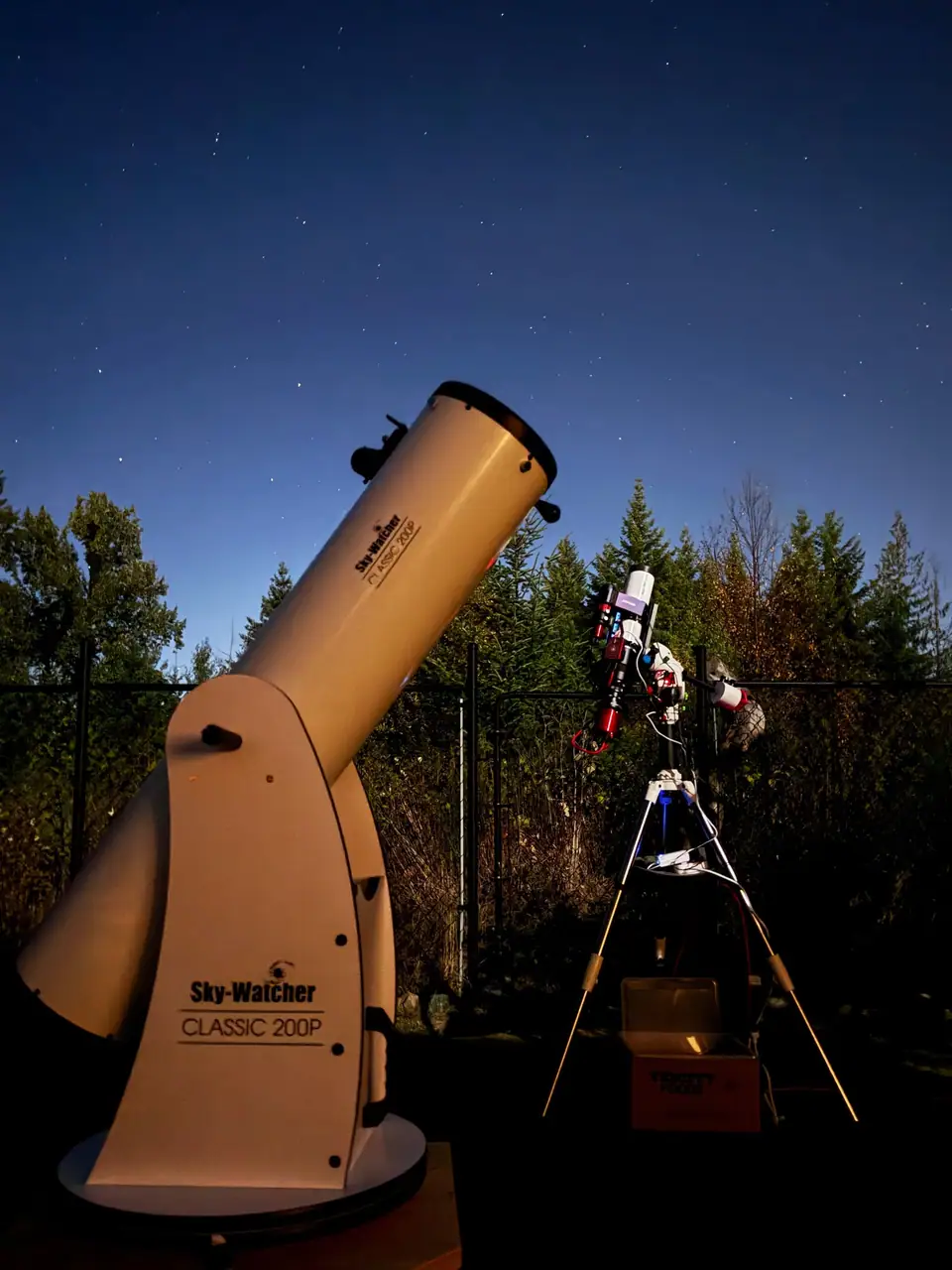
The mount is what makes it a Dobsonian. The tube sits in a wooden rocker box and moves two ways: around (azimuth) and up and down (altitude). Sky-Watcher’s manual says there is no tracking, so you nudge the tube by hand to follow an object as the Earth turns.
NASA’s Night Sky Network recommends this layout for a first telescope: a reflector on a tabletop or Dobsonian mount, with a mirror between 4.5 and 8 inches. Its reason is speed. You carry it outside, set it down and start observing.
If you are still deciding between mirrors and lenses, the refractor vs reflector comparison covers the other designs.
6-inch vs 8-inch Dobsonian: size and weight
These figures come from Sky-Watcher’s specification pages, and from High Point Scientific’s spec sheet for the Apertura AD8.
| Model | Aperture | Focal length | Focal ratio | Tube weight | Eyepiece barrel |
|---|---|---|---|---|---|
| Sky-Watcher Classic 6-inch (150P) | 153 mm | 1200 mm | f/7.8 | 5.78 kg (about 12.7 lb) | 2 in with 1.25 in adapter |
| Sky-Watcher Classic 8-inch (200P) | 203 mm | 1200 mm | f/5.9 | 11 kg (about 24 lb) | 2 in with 1.25 in adapter |
| Apertura AD8 | 203.2 mm | 1200 mm | f/5.9 | 24.5 lb | 2 in with 1.25 in adapter |
Two things stand out. First, both Sky-Watcher sizes share a 1200 mm focal length, so the 6-inch is not a much shorter telescope. Sky-Watcher lists the 8-inch tube at 112 cm long (about 44 inches), and the AD8’s tube is 46.13 inches. Plan storage and car space around a tube close to four feet long for either size.
Second, the weight nearly doubles. The 8-inch tube is 11 kg against 5.78 kg. The base adds more: the AD8’s base is 27.7 lb, for 52.2 lb in total. You carry the tube and the base in two trips, so judge the heavier single lift. If it is too much for the person who will use the telescope, the 6-inch is the better buy.
What will you see with each size?
Sky-Watcher gives three numbers for the pair. Its 6-inch Classic is “460 times brighter than the human eye” and its 8-inch is “816 times brighter”, which it sums up as a 78% gain for the 8-inch. It lists the faintest star each can reach as magnitude 13.6 and 14.2, and the highest practical power as 306x and 406x.
In plain terms, the 8-inch reaches fainter objects and holds more magnification. That matters most for galaxies, nebulae and globular clusters, which are dim. Celestron lists deep-sky objects as the main strength of Newtonians with larger apertures.
For a first target list, NASA’s Night Sky Network names the Moon, open clusters such as the Pleiades, the Andromeda Galaxy, the Orion Nebula, Jupiter’s moons and some globular clusters. Both sizes cover that list.
Magnification comes from the eyepiece. Sky-Watcher’s manual gives the formula: telescope focal length divided by eyepiece focal length. The 20 mm and 12.5 mm eyepieces listed with both Classic models give 60x and 96x at 1200 mm.
The same manual warns that the air limits what high power shows: you end up magnifying the turbulence between you and the target. Its rule of thumb is about 2x per millimeter of aperture under good conditions. The eyepieces and filters guide explains what to add after the supplied pair.
6-inch, 8-inch and tabletop Dobsonians
Shop the range
Browse current dobsonian telescopes on eBay.
Shop dobsonian telescopesOpens eBay in a new tab. Check condition, seller feedback and returns on the listing.
Current eBay listings for dobsonian telescopes, shown by eBay
What to look for in a Dobsonian
- Focal ratio. Celestron says Newtonians at f/6 and lower show coma (stretched stars at the edge) and need regular collimation. At f/7.8 the 6-inch is the more forgiving of the two.
- Focuser. All three full-size models above take 2-inch eyepieces through an adapter as well as 1.25-inch. The AD8’s is a dual-speed Crayford type; Sky-Watcher’s 6-inch uses a rack-and-pinion.
- Finder. Sky-Watcher supplies a 6x30 finder on the 6-inch and a 9x50 on its US 8-inch. The AD8 comes with an 8x50 right-angle finder.
- What is in the box. The AD8 dealer spec lists 9 mm and 30 mm eyepieces, a collimation tool, a Moon filter and a mirror cooling fan.
Tabletop Dobsonians: Heritage 130P and 150P
A tabletop Dobsonian keeps the same optics on a small one-arm base. Sky-Watcher’s Heritage models use a collapsible tube that slides shut for storage.
| Model | Aperture | Focal length | Focal ratio | Size and weight |
|---|---|---|---|---|
| Sky-Watcher Heritage 130P | 130 mm | 650 mm | f/5 | Collapses to 14.5 in; under 14 lb in total |
| Sky-Watcher Heritage 150P | 150 mm | 750 mm | f/5 | Collapsible tube; weight not listed on the maker page |
Both use a 1.25-inch helical focuser, and the 130P comes with 25 mm and 10 mm eyepieces and a red dot finder. The base has rubber feet and needs a steady table or stool at a comfortable height, so check that before buying one for a balcony.
The trade for the small size is the f/5 focal ratio, which by Celestron’s guidance needs collimation more often than the f/7.8 full-size 6-inch.
Collimation and cool-down, briefly
Collimation is the one chore a Dobsonian asks of you. Sky-Watcher’s manual defines it as aligning the mirrors so they “work in concert” to deliver focused light to the eyepiece.
The check is quick. Center a star, turn the focuser slightly out of focus, and look at the rings. If they are symmetrical around the center, the manual says the optics are aligned. If not, three screws behind the primary mirror and three on the secondary holder bring them back.
Mirrors also need time to reach outdoor temperature. Sky-Watcher’s manual says at least 10 to 30 minutes, longer for larger optics.
Is an Orion SkyQuest still worth buying?
Orion sold its Dobsonians under the SkyQuest name, and they still turn up secondhand. They are a used buy only. ScopeTrader, an astronomy trade news site, reported on July 12, 2024 that Optronic Technologies, the parent of Orion Telescopes & Binoculars and Meade Instruments, closed its Watsonville, California offices and dismissed its staff on July 9, 2024.
With no maker page left to cite, this guide gives no SkyQuest specs. Ask the seller for the tube length and weight, and check the mirrors, focuser and base using the used telescope checklist.
Where a Dobsonian fits
A Dobsonian suits someone who wants to look through an eyepiece and find objects by hand. It does not point itself and it does not track. For other starting points, including small refractors and app-guided models, see telescopes for beginners, or go back to the stargazing gear overview for the full path from binoculars upward.
Frequently asked questions
Which Dobsonian is better, a 6-inch or an 8-inch?
The 8-inch shows more: Sky-Watcher says its 8-inch Classic is 78% brighter than its 6-inch. The 6-inch is easier to live with, since Sky-Watcher lists its tube at 5.78 kg against 11 kg for the 8-inch. Choose by what you can carry and store.
How heavy is an 8-inch Dobsonian?
The dealer spec for the Apertura AD8 lists a 24.5 lb tube and a 27.7 lb base, 52.2 lb in total. Sky-Watcher lists the tube of its 8-inch Classic at 11 kg, about 24 lb. The tube and base are carried separately.
Do Dobsonian telescopes need collimation?
Yes. Sky-Watcher's manual describes collimation as aligning the mirrors so they deliver focused light to the eyepiece, and it explains how to check it on a slightly defocused star. Celestron says Newtonians at f/6 and lower need it regularly.
Can you see planets with a Dobsonian?
Yes. Celestron lists the Moon, planets and deep-sky objects as targets for Newtonian reflectors, the design inside every Dobsonian. A Dobsonian base does not track, so Sky-Watcher's manual says to nudge the tube to keep a planet in view.
Can you still buy an Orion SkyQuest Dobsonian?
Only used. ScopeTrader reported on July 12, 2024 that Orion's parent company, Optronic Technologies, closed its Watsonville, California offices and dismissed its staff on July 9, 2024. Treat a SkyQuest as a secondhand purchase with no maker support.
Sources
- Eclipse Viewing SafetyNASA
- Solar Filters for Optics: Telescopes, Binoculars & CamerasAmerican Astronomical Society
- DOB 6" Traditional (specifications)Sky-Watcher
- DOB 8" Traditional (specifications)Sky-Watcher
- Classic 150P DobsonianSky-Watcher USA
- Classic 200P DobsonianSky-Watcher USA
- Heritage P130 (specifications)Sky-Watcher
- Heritage 130 Tabletop DobsonianSky-Watcher USA
- Heritage 150 Tabletop DobsonianSky-Watcher USA
- Apertura AD8 8-inch Dobsonian Telescope (specifications)High Point Scientific
- Dobsonians instruction manual (150mm, 200mm, 254mm)Sky-Watcher
- The Ultimate Guide to Celestron Optical TubesCelestron
- How to Choose a First TelescopeNASA Night Sky Network
- Meade and Orion close California officesScopeTrader
Filed under TelescopesStart here: Stargazing Gear for Beginners: What to Buy First, and in What Order
Next rungs on the ladder
Start here
Stargazing Gear for Beginners: What to Buy First, and in What Order
A beginner's path through stargazing gear: eyes and a chart, binoculars, a first telescope, then upgrades and smart telescopes, with sourced specs.
Roundup
Telescopes for Beginners: What to Buy First, by Budget and Sky
How to choose a first telescope by budget band and by sky: aperture explained, what each size shows according to NASA, and maker weights to check.
Buying guide
Buying a Used Telescope: What to Check, Fair Makers and Red Flags
A checklist for buying a used telescope: optics, mirror coatings, mount, missing parts, shipping damage, eBay condition terms and the status of Meade and Orion.
Comparison
Celestron NexStar 4SE, 6SE and 8SE vs StarSense Explorer Compared
NexStar 4SE, 6SE and 8SE against the StarSense Explorer DX 130AZ: aperture, focal length, mount, alignment, power and weight from Celestron's own pages.