Binoculars and accessoriesBuying guide
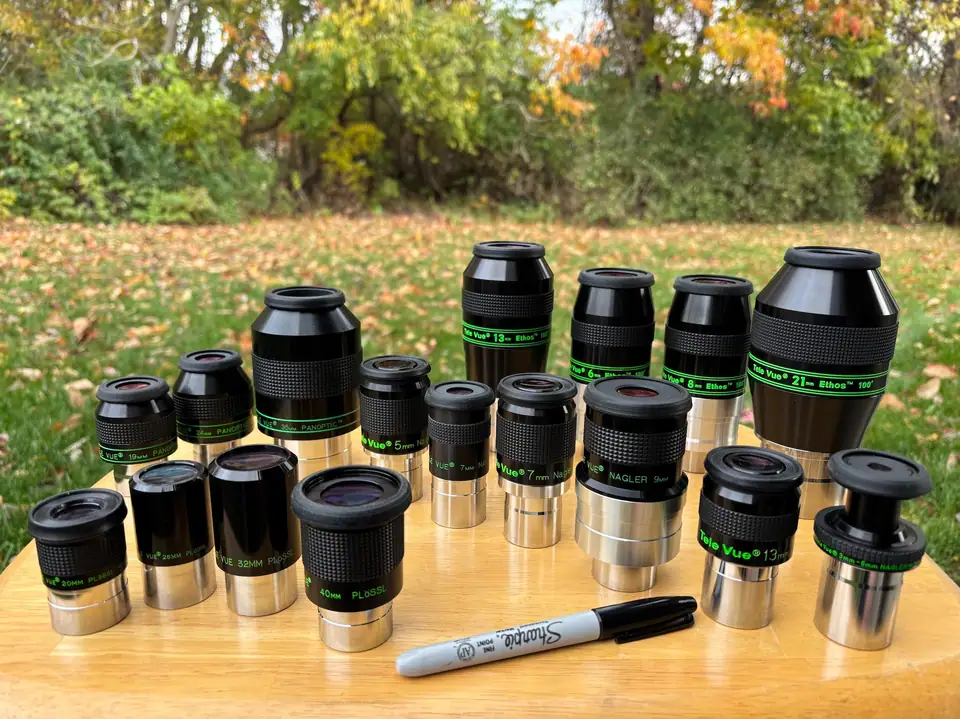
Telescope Eyepieces, Barlow Lenses and Filters: What to Add First
Which telescope accessories to buy first: a low-power eyepiece, a 2x Barlow and a Moon filter, with the magnification math, finder types and solar filter rules.
We earn from qualifying purchases through links on this page. How we make money.
On this page
Add a low-power eyepiece first, then a 2x Barlow lens, then a neutral density Moon filter. Magnification is the telescope’s focal length divided by the eyepiece’s focal length, and Celestron puts the highest useful magnification at 60x per inch of aperture. Solar filters are a separate purchase: buy them from a maker on the American Astronomical Society’s supplier list.
Sun safety
Never point a telescope, binoculars, a finder scope or a camera at the Sun without a special-purpose solar filter secured over the front of the optics. NASA says viewing the Sun through unfiltered optics “will instantly cause severe eye injury”, and that eclipse glasses must never be used with a telescope, binoculars or a camera. The American Astronomical Society adds that a finder scope must be capped, removed or filtered too, and that solar filters made to thread into an eyepiece are dangerous.
How do you calculate telescope magnification?
Celestron’s knowledgebase gives the formula in one line: telescope focal length divided by eyepiece focal length equals magnification. Both numbers are in millimeters. The eyepiece’s number is the one you change, and a shorter eyepiece gives a higher power.
Celestron works the math on its AstroMaster 130EQ, which has a 650 mm focal length and a 130 mm aperture. The same arithmetic covers any eyepiece:
| Eyepiece focal length | Magnification at 650 mm | With a 2x Barlow |
|---|---|---|
| 25 mm | 26x | 52x |
| 10 mm | 65x | 130x |
| 2.3 mm (Celestron’s example) | 282x | Past the limit |
What is the maximum useful magnification?
Celestron defines the highest useful magnification as 60x per inch (25.4 mm) of aperture, and the lowest as 3.6x per inch. For the 130 mm example that is about 307x at the top and about 19x at the bottom.
Past the top figure, Celestron says the image is magnified but carries no more detail. Below the bottom figure, the beam of light leaving the eyepiece becomes wider than the eye can take in. Celestron adds that performance is always limited by seeing conditions, meaning how steady the air is.
Astronomy magazine’s Glenn Chaple uses a stricter rule of 50x per inch of aperture: “Any higher and you risk dim, fuzzy images.” The same article treats a high magnification claim as a warning sign on a telescope box, which is why aperture comes first in the beginner telescope guide.
What should you add first?
The order below follows from the formula and the limits above.
- A low-power eyepiece. The longer the eyepiece’s focal length, the lower the magnification, and a low power makes targets easier to find and frames large objects. Run your telescope’s numbers first so the result stays above Celestron’s 3.6x per inch floor.
- A 2x Barlow lens. Celestron describes its X-Cel LX 2x Barlow as a lens that, “inserted between the eyepiece and telescope”, doubles the magnification of every 1.25 inch eyepiece. Two eyepieces become four powers. Its barrel is also threaded for 1.25 inch filters, so a filter can stay on the Barlow while eyepieces are swapped.
- A Moon filter. Celestron’s neutral density Moon filter transmits 13 percent of the light. It darkens all colors evenly, so the Moon keeps its natural color, and Celestron also suggests it for Venus, Jupiter and bright double stars.
A Dobsonian owner follows the same order, using the focal length from the Dobsonian telescope guide or the maker’s spec page.
Eyepieces, Barlow lenses, Moon filters and red dot finders
Shop the range
Browse current eyepieces, Barlow lenses and filters on eBay.
Shop eyepieces, Barlow lenses and filtersOpens eBay in a new tab. Check condition, seller feedback and returns on the listing.
Current eBay listings for eyepieces, Barlow lenses and filters, shown by eBay
This slot leaves out solar filters and eclipse viewers on purpose; the section below explains where to buy those.
Which barrel size do you need: 1.25 inch or 2 inch?
Eyepieces, Barlows and filters are sold by barrel diameter, and the two sizes on maker pages are 1.25 inch and 2 inch. Check the focuser on your telescope before buying anything.
Celestron sells a twist-lock adapter that lets 1.25 inch eyepieces and accessories fit a 2 inch eyepiece holder. It was designed, in Celestron’s words, for observers “who use both 2” and 1.25” eyepieces regularly”. A telescope with a 1.25 inch focuser is limited to 1.25 inch eyepieces.
Filters follow the same sizes. Celestron’s Moon filter threads onto its 1.25 inch eyepieces and is threaded on both sides, so it stacks with a second filter.
Red dot finder or finder scope?
Celestron’s finder guide describes three kinds:
- Red dot finder. It projects a red dot or reticle on a small window, so you aim with both eyes open. Celestron’s StarPointer has 1x (no) magnification and a wide field of view, and it uses an LED, not a laser.
- Straight-through optical finder. A miniature telescope, usually 6x to 10x with an aperture of 24 to 50 mm by Celestron’s figures. The view is upside down compared with the naked eye.
- Right-angle correct-image (RACI) finder. It shows the sky right side up and left-to-right correct, and the angled eyepiece spares your neck.
Every finder has to be aligned with the main telescope, and Celestron says to do that during the day on a distant landmark. Never sweep near the Sun while doing it.
Do light pollution filters work?
They help with one class of object. Celestron describes its light pollution reduction filters as cutting specific wavelengths from artificial light, “mercury vapor, and both high and low pressure sodium vapor lights”, plus natural sky glow. Its UHC/LPR filter is sold for emission nebulae, where Celestron says the sky background darkens and contrast is “noticeably improved”.
Celestron makes no such claim for galaxies or star clusters on that page. Treat a nebula filter as a later purchase, after the eyepieces. For photography from a city, the astrophotography gear guide covers filters used with cameras.
Where should you buy a solar filter?
Not from a marketplace listing. A listing title cannot show whether a filter is genuine or undamaged, and the stakes are your eyesight.
Where to buy a solar filter
The American Astronomical Society keeps a list of suppliers of safe solar viewers and filters. Its advice is to buy “directly from known manufacturers or any authorized dealers those manufacturers publicly identify.” The same page says buying from online marketplaces or retailers who know nothing about solar observing “is not worth the risk to your eyes.” In practice that means the maker’s own store or a dealer the maker names.
The AAS rules for the filter itself are short:
- It “must be attached to the front of your telescope, binoculars, or camera lens”, so sunlight is cut before it is concentrated.
- Filters that attach at the eyepiece, the kind once packed with inexpensive telescopes, are dangerous: the AAS says sunlight concentrated by the optics will burn through them.
- It has to be secure enough that a bump or a gust of wind cannot knock it off.
- The finder is capped, removed or filtered the same way.
The AAS lists three filter materials: metal on glass, aluminized polyester film and black polymer. BBC Sky at Night Magazine’s secondhand buying guide advises against used solar filters altogether.
Where to go next
Binocular owners can skip most of this list, since binoculars have fixed eyepieces; the binoculars for stargazing guide explains their numbers. For the full path from first chart to first telescope, start at the stargazing gear overview.
Frequently asked questions
How do I calculate telescope magnification?
Divide the telescope's focal length by the eyepiece's focal length, both in millimeters. Celestron's example is a 650 mm telescope with a 2.3 mm eyepiece, which gives 282x.
What is the maximum useful magnification of a telescope?
Celestron defines it as 60x per inch of aperture, which works out to about 307x for a 130 mm telescope. Astronomy magazine uses a more cautious 50x per inch and warns that going higher risks dim, fuzzy images.
What does a 2x Barlow lens do?
It sits between the eyepiece and the telescope and doubles the magnification of each eyepiece used with it, as Celestron describes its X-Cel LX 2x Barlow. Two eyepieces plus a 2x Barlow give four magnifications.
Do I need a Moon filter?
It is a comfort accessory. Celestron's neutral density Moon filter passes 13 percent of the light, which cuts glare without shifting the color.
Are eyepiece solar filters safe?
No. The American Astronomical Society calls solar filters that attach at the eyepiece dangerous, because sunlight concentrated by the optics burns through them. A solar filter has to cover the front of the telescope.
Can I use 2 inch eyepieces in a 1.25 inch focuser?
A 2 inch eyepiece needs a 2 inch eyepiece holder. The adapters makers sell go the other way: Celestron's twist-lock adapter lets 1.25 inch eyepieces fit a 2 inch holder.
Sources
- Eclipse Viewing SafetyNASA
- Solar Filters for Optics: Telescopes, Binoculars & CamerasAmerican Astronomical Society
- Suppliers of Safe Solar Viewers & FiltersAmerican Astronomical Society
- How to Determine Which Eyepieces to Use with Your TelescopeCelestron
- The beginner's guide to buying a used telescopeAstronomy magazine
- X-Cel LX 2x Barlow Lens, 1.25 inchCelestron
- 2 inch to 1.25 inch Adapter with Twist-LockCelestron
- Neutral Density Moon Filter, 1.25 inchCelestron
- UHC/LPR Filter, 1.25 inchCelestron
- Finderscopes Explained: Making Astronomy Easier and More FunCelestron
- How to buy a secondhand telescope, binoculars, camera and other astronomy kitBBC Sky at Night Magazine
Filed under Binoculars and accessoriesStart here: Stargazing Gear for Beginners: What to Buy First, and in What Order
Next rungs on the ladder
Start here
Stargazing Gear for Beginners: What to Buy First, and in What Order
A beginner's path through stargazing gear: eyes and a chart, binoculars, a first telescope, then upgrades and smart telescopes, with sourced specs.
Buying guide
Binoculars for Stargazing: 10x50, 15x70 and 25x70 Explained
What 10x50 means, how exit pupil works, which sizes you can hold by hand, and Celestron SkyMaster 12x60, 15x70, 25x70 and 20x80 specs compared.
Roundup
Telescopes for Beginners: What to Buy First, by Budget and Sky
How to choose a first telescope by budget band and by sky: aperture explained, what each size shows according to NASA, and maker weights to check.
Buying guide
Astrophotography Gear for Beginners: Trackers, Cameras and Mounts
What to buy first for night sky photos: a tripod and remote, a star tracker such as the Star Adventurer or SkyGuider Pro, or a smart telescope. Specs sourced.