TelescopesRoundup
Telescopes for Kids: What Works for Ages 6 to 12, and What to Skip
Choosing a child's first telescope: weights a kid can carry, why aperture beats magnification, the age label to read, and CPSC small parts and battery rules.
We earn from qualifying purchases through links on this page. How we make money.
On this page
For ages 6 to 12, pick a small telescope the child can carry and aim alone: a tabletop reflector or a 50 to 70 mm refractor on a steady mount, used at low power. Skip anything sold on its magnification. Read the age label on the box, never the listing title, and supervise every daytime use.
Sun safety
Never point a telescope, binoculars, a finder scope or a camera at the Sun without a special-purpose solar filter secured over the front of the optics. NASA says viewing the Sun through unfiltered optics “will instantly cause severe eye injury”, and that eclipse glasses must never be used with a telescope, binoculars or a camera. The American Astronomical Society adds that a finder scope must be capped, removed or filtered too, and that solar filters made to thread into an eyepiece are dangerous.
For parents: a child should never use a telescope in daylight without an adult standing next to it. A child sweeping the sky for the Moon in the afternoon can cross the Sun by accident. Store the telescope capped and indoors, not on a sunny windowsill.
What should a kids’ telescope be able to do?
Show the Moon sharply and stay where it is pointed. NASA’s skywatching FAQ says binoculars or a small telescope reveal the large moons of Jupiter and the rings of Saturn, along with star clusters and double stars. Those are the targets a child’s telescope is for.
The rest is about handling. A short checklist:
- The child can lift it and carry it to the yard.
- Setup needs no tools.
- The mount moves smoothly and does not shake when touched.
- The lowest-power eyepiece gives a wide view, so targets are easy to find.
- The box carries a clear age grade.
Which telescope suits which age?
No agency publishes age bands for telescopes, so the bands below are our reading of maker weights and of how the Astronomical League structures its youth programs.
| Age | What suits | Why |
|---|---|---|
| Under 3 | No telescope kit | CPSC’s small parts ban covers products for this age, and eyepieces and caps are small |
| About 6 to 10 | Binoculars and a planisphere, or a tabletop telescope an adult helps aim | The League’s Sky Puppy program for ages 10 and under uses eyes, inexpensive binoculars and charts, with a mentor |
| About 8 to 12 | A 50 to 80 mm refractor or a 76 to 114 mm tabletop reflector the child sets up alone | Kits in this range weigh a few pounds to around 12 lb on maker pages |
| 11 and up | A full beginner telescope | The League’s Youth Astronomer program for ages 11 through 17 allows any equipment |
The bands overlap because children differ. A patient 7-year-old with a parent nearby can use a telescope that frustrates an impatient 11-year-old.
For the youngest group, binoculars are a serious option, not a consolation prize. The Sky Puppy program asks children to find five deep-space objects with them. The binoculars for stargazing guide covers sizes, and lighter pairs suit small hands.
How heavy is too heavy?
Weights below come from Celestron’s specification pages.
| Telescope (maker page) | Type | Aperture | Included eyepiece powers | Weight |
|---|---|---|---|---|
| Celestron Kids 50mm Refractor with Case | Refractor, metal tabletop tripod | 50 mm | 30x and 63x | 1 lb telescope, 3.8 lb with hard case |
| Celestron FirstScope | Tabletop reflector | 76 mm | 15x and 75x | Not listed on the page we read |
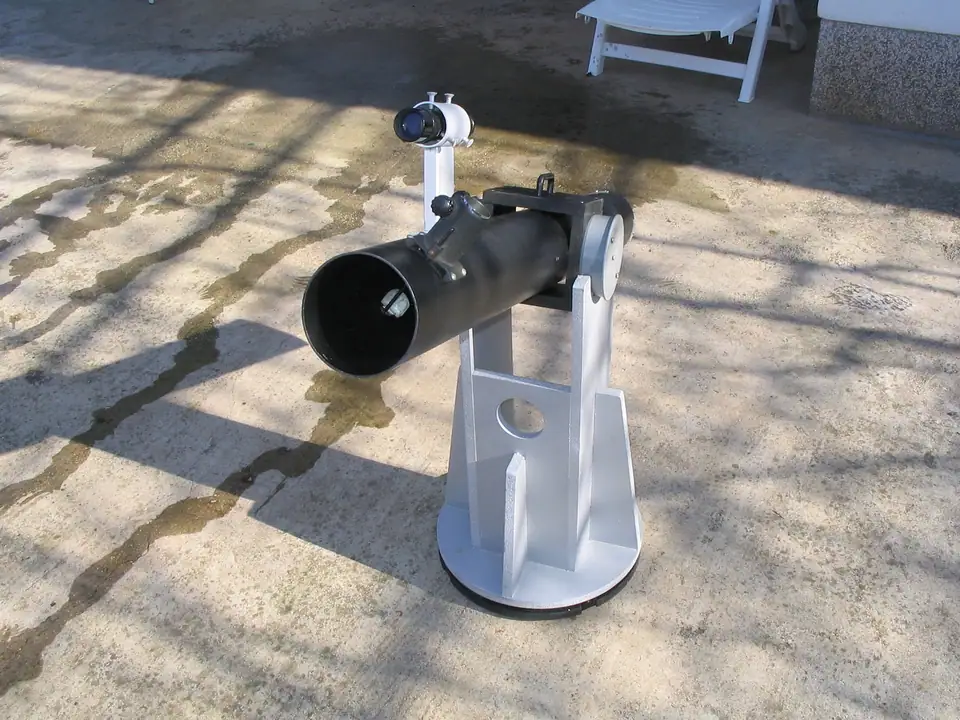
| Celestron StarSense Explorer 114mm Dobsonian | Tabletop reflector | 114 mm | 26x and 45x | 12.6 lb |
| Celestron AstroMaster 70AZ | Refractor, full-height tripod | 70 mm | 45x and 90x | 10.8 lb |
A tabletop telescope has no tripod legs to extend or trip over. Celestron describes the FirstScope as easy to store, transport and set up: the user moves the tube toward the target by hand. It needs a solid surface at the right height, such as a patio table or an upturned crate.
A tripod-mounted refractor stands on its own. Celestron lists the AstroMaster 70AZ with a no-tool setup and a tripod that adjusts from 32 to 51 inches, which covers a range of heights as a child grows.
Kids' telescopes: tabletop and small refractor kits
Shop the range
Browse current telescopes for kids on eBay.
Shop telescopes for kidsOpens eBay in a new tab. Check condition, seller feedback and returns on the listing.
Current eBay listings for telescopes for kids, shown by eBay
Why is magnification not the number to shop by?
Because any telescope can be pushed to a high power, and the result is a dim blur. The Smithsonian National Air and Space Museum’s buying tips say to stay away from any telescope advertised for its magnifying power. Astronomer Andrew Fraknoi’s 2025 buying guide says magnification is not a criterion for choosing a telescope at all, since it changes with the eyepiece.
Celestron’s knowledge base gives the limit: 50 to 60 times the aperture in inches, under ideal conditions. A 50 mm telescope is about 2 inches across, so its ceiling is roughly 100x to 120x. Celestron adds that most observing is done at 6 to 25 times the aperture in inches, where the image is brighter and crisper.
Two things follow for a child’s telescope:
- Low power is the friendly power. At 15x to 30x the Moon fits in the view and stays there long enough to look. At high power the view is narrow, the target slides out of it as Earth turns, and a young child has trouble finding it again without help.
- A Barlow lens multiplies the problem. A 3x Barlow triples the power of any eyepiece, which on a small telescope’s shortest eyepiece passes the ceiling above. Treat it as an extra, and start every session with the longest eyepiece (the one with the biggest number in millimeters).
Aperture is the honest number. Fraknoi’s guide explains that a larger aperture gathers more light and shows fainter objects.
What should you skip?
Without naming products, these are the signs to pass on:
- A box or listing that leads with a magnification figure.
- No aperture stated in millimeters.
- A tall, thin tripod that sways when you tap it. Fraknoi’s guide calls the mount one of a telescope’s most critical elements.
- No age grade on the packaging.
- A small threaded “sun” filter for the eyepiece in the accessory bag. The American Astronomical Society calls these dangerous. Throw it away.
The Smithsonian’s tips add that most of the cheapest telescopes have low optical quality, and that binoculars are the better purchase at that level.
What if the child is ready for more?
A child of 11 or 12 who already knows a few constellations can handle the telescopes adults start with. The beginner telescope guide compares them by budget band and by sky, with weights.
Step-up telescopes for older kids and families
Shop the range
Browse current beginner telescopes on eBay.
Shop beginner telescopesOpens eBay in a new tab. Check condition, seller feedback and returns on the listing.
Current eBay listings for beginner telescopes, shown by eBay
Which safety labels should you read?
Read the age label on the box or the maker’s page. A marketplace listing title is written by a seller and proves nothing about age grading.
Small parts. CPSC’s small parts regulation, 16 CFR part 1501, bans children’s products intended for children under 3 that present a choking, aspiration or ingestion hazard because of small parts. CPSC also notes that certain toys containing small parts must carry a label warning buyers not to purchase them for children under a stated age. Eyepieces, lens caps and finder parts are small. In a house with a toddler, they go back in the case after every use.
Button and coin batteries. Check whether a red dot finder, a remote or a planetarium projector takes button or coin cells. Reese’s Law, enacted in 2022 and implemented at 16 CFR part 1263, requires that compartments for replaceable button cell or coin batteries need a tool, or at least two independent and simultaneous hand movements, to open. CPSC’s guidance says the rule covers consumer products made or imported after October 23, 2023, and requires warnings on the packaging.
Toys follow a parallel route. CPSC defines a toy as a product designed, manufactured or marketed as a plaything for children under 14, and toys must meet the battery requirements of the toy standard (ASTM F963, at 16 CFR part 1250) instead. Either way, check that the battery door is secured before a child handles the finder, and treat an older, secondhand finder with a loose door as something to fix or replace.
What goes with a first telescope?
If the telescope is a present, the stargazing gifts guide pairs it with a Moon map or a planisphere, which gives a child something to do on cloudy nights. For the wider kit, from red flashlights to star charts, see the stargazing gear overview.
Frequently asked questions
What age is right for a first telescope?
There is no official age. The Astronomical League's program for observers aged 10 and under asks only for eyes, inexpensive binoculars, paper and a planisphere, with a mentor alongside. Its Youth Astronomer program for ages 11 through 17 allows any equipment.
How much magnification should a kids' telescope have?
Low power works best. Celestron puts the usable maximum at 50 to 60 times the aperture in inches under ideal conditions, so a 50 mm telescope tops out near 100x to 120x, and most observing is done far below that.
Can a child see planets with a small telescope?
NASA's skywatching FAQ says binoculars or a small telescope make visible the large moons of Jupiter and the rings of Saturn. The planets look small in the eyepiece, so it helps to tell a child that before the first night out.
Are kids' telescopes safe for toddlers?
Telescope kits include small eyepieces and caps. CPSC rules ban small parts in products intended for children under 3 (16 CFR 1501), so read the age label on the box and keep loose parts away from younger siblings.
Do kids' telescopes use button batteries?
Check the finder and any remote for a coin cell before a child handles them. Under Reese's Law, CPSC requires a compartment for replaceable button cell or coin batteries to need a tool, or two independent and simultaneous hand movements, to open.
Can kids look at the Sun or an eclipse through a telescope?
Only with a special-purpose solar filter fixed over the front of the telescope, and with an adult running the session. NASA says unfiltered optics cause instant, severe eye injury, and eclipse glasses must never be used with a telescope.
Sources
- Eclipse Viewing SafetyNASA
- Solar Filters for Optics: Telescopes, Binoculars & CamerasAmerican Astronomical Society
- Small Parts Ban and Choking Hazard LabelingU.S. Consumer Product Safety Commission
- Button Cell and Coin Battery Business GuidanceU.S. Consumer Product Safety Commission
- Toy Safety Business Guidance and Small Entity Compliance GuideU.S. Consumer Product Safety Commission
- Celestron Kids 50mm Refractor with Case: specificationsCelestron
- FirstScope Telescope: specificationsCelestron
- AstroMaster 70AZ Telescope: specificationsCelestron
- StarSense Explorer 114mm Tabletop Dobsonian: specificationsCelestron
- What is magnification/power as it pertains to telescopes?Celestron
- Tips for Telescope Buying (Shauna Edson, December 20, 2015)Smithsonian National Air and Space Museum
- A Buying Guide for a First Telescope (Andrew Fraknoi, 2025)Andrew Fraknoi
- Sky Puppy Observing ProgramAstronomical League
- Youth Astronomer Observing ProgramAstronomical League
- Skywatching FAQNASA
Filed under TelescopesStart here: Stargazing Gear for Beginners: What to Buy First, and in What Order
Next rungs on the ladder
Start here
Stargazing Gear for Beginners: What to Buy First, and in What Order
A beginner's path through stargazing gear: eyes and a chart, binoculars, a first telescope, then upgrades and smart telescopes, with sourced specs.
Roundup
Telescopes for Beginners: What to Buy First, by Budget and Sky
How to choose a first telescope by budget band and by sky: aperture explained, what each size shows according to NASA, and maker weights to check.
Buying guide
Buying a Used Telescope: What to Check, Fair Makers and Red Flags
A checklist for buying a used telescope: optics, mirror coatings, mount, missing parts, shipping damage, eBay condition terms and the status of Meade and Orion.
Comparison
Celestron NexStar 4SE, 6SE and 8SE vs StarSense Explorer Compared
NexStar 4SE, 6SE and 8SE against the StarSense Explorer DX 130AZ: aperture, focal length, mount, alignment, power and weight from Celestron's own pages.