GiftsRoundup
Stargazing Gifts by Person: Telescopes, Binoculars, Books, Projectors
Stargazing gift ideas matched to eight kinds of people, from a Moon-curious kid to a seasoned observer, with LED planetarium projectors, books and binoculars.
We earn from qualifying purchases through links on this page. How we make money.
On this page
Match the gift to how the person looks at the sky. NASA’s Night Sky Network calls binoculars an excellent first instrument, so they suit most beginners. A planisphere or a guidebook such as NightWatch works alongside any instrument, an LED home planetarium suits the space fan who stays indoors, and a telescope is for someone ready to learn it.
Sun safety
Never point a telescope, binoculars, a finder scope or a camera at the Sun without a special-purpose solar filter secured over the front of the optics. NASA says viewing the Sun through unfiltered optics “will instantly cause severe eye injury”, and that eclipse glasses must never be used with a telescope, binoculars or a camera. The American Astronomical Society adds that a finder scope must be capped, removed or filtered too, and that solar filters made to thread into an eyepiece are dangerous.
If the gift is binoculars or a telescope, say this out loud when it is unwrapped, and supervise any child who uses it in daylight.
Which stargazing gift fits which person?
| The person | Gift ideas | Read first |
|---|---|---|
| The curious kid who asks about the Moon | A child-sized telescope, a Moon map, an LED planetarium projector | Telescopes for kids |
| The teen who wants to photograph the night sky | A smart telescope or a star tracker for a camera | Smart telescopes compared |
| The city apartment dweller with a balcony | Binoculars, a small refractor, a light pollution filter | Binoculars for stargazing |
| The camper and road-tripper | Binoculars, a red flashlight, a planisphere | The books and charts section below |
| The grandparent who wants a shared hobby | A Dobsonian telescope and a star atlas | Dobsonian telescopes |
| The space fan who does not observe | A Moon lamp, a home planetarium, NASA-themed books | The projector section below |
| The amateur astronomer who has everything | An eyepiece, a dew heater, an observing chair | Eyepieces and filters |
| The teacher or scout leader | Several pairs of binoculars and a set of planispheres | Binoculars for stargazing |
Notes on four of them
The teen photographer. A smart telescope handles finding and imaging through an app, while a star tracker moves an ordinary camera with the sky. The astrophotography gear guide explains both routes, so read it before choosing.
The camper. NASA’s Night Sky Network notes that eyes take about 30 minutes to adapt to the dark, and that a red light lets the pupils stay dilated longer than white light does. A red flashlight is a small gift that an observer uses every night out.
The observer who has everything. Do not guess at a telescope. Ask which barrel size their eyepieces use, then pick an accessory that fits; the eyepiece guide linked in the table explains the sizes.
The teacher or scout leader. A group shares binoculars more easily than one telescope, since nobody waits in line at an eyepiece. NASA’s note that binoculars travel well applies to a troop van too.
Are star projectors a good gift?
For the space fan who stays indoors, yes, with one condition: choose an LED planetarium projector, not a laser “galaxy” light. Sega Toys’ projectors shine an LED through interchangeable star discs, so the ceiling shows a mapped star field.
The Sega Toys Homestar is the reference point for the type. Sega Toys lists these details for the Homestar Original on its own page:
- a 3-watt white LED as the light source
- “60 000 twinkling stars” from interchangeable discs, with two northern sky discs in the box (one with constellation lines)
- a projection distance of 150 to 230 cm (59 to 90 inches) with adjustable focus, giving a circle about 270 cm (106 inches) across
- rotating movement, a shooting star function and a sleep timer
- an age grade of 6 years and up
Sega Toys describes its Homestar Flux as the most powerful model in the line, with a 5-watt LED and glass lenses. Measure the distance from the bedside table to the ceiling before buying, since the focus range has limits.
LED planetarium and star projectors
Shop the range
Browse current planetarium and star projectors on eBay.
Shop planetarium and star projectorsOpens eBay in a new tab. Check condition, seller feedback and returns on the listing.
Current eBay listings for planetarium and star projectors, shown by eBay
The projector listings above leave out laser models. The U.S. Food and Drug Administration warns that laser light aimed into the eye “can be more damaging than staring directly into the sun”, and it advises against buying laser pointers for children. This site does not recommend laser pointers or laser projectors as gifts.
Which books and star charts make good gifts?
A book or chart works for nearly every person in the table, and it cannot be the wrong size.
NightWatch: A Practical Guide to Viewing the Universe, by Terence Dickinson, is published by Firefly Books. Space.com reported that its fifth edition, revised by Ken Hewitt-White, was due on September 7, 2023, and quoted the publisher’s synopsis: the text was revised throughout, with eclipse and planet tables running to 2035. It is a general introduction, so it suits someone who owns no equipment yet.
Turn Left at Orion, by Guy Consolmagno and Dan M. Davis, is published by Cambridge University Press. Its subtitle promises hundreds of night sky objects to see in a home telescope, and how to find them. A bookseller listing describes the fifth edition as spiral bound, so it lies flat outdoors. Give it with a telescope, or to someone who has one.
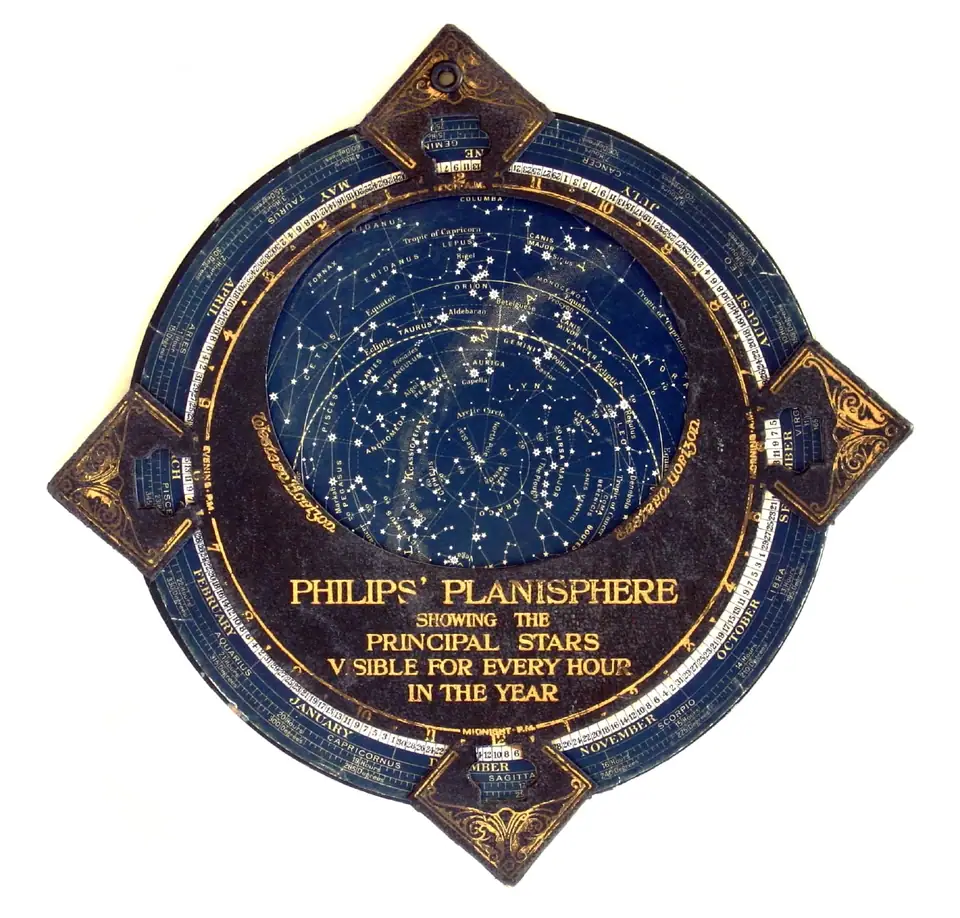
A planisphere is, in EarthSky’s words, “a rotating star locator” that “shows you what’s overhead any night of the year.” You turn the wheel to line up the date with the time. EarthSky’s one buying rule: order it for the right hemisphere and latitude. NASA’s Night Sky Network also suggests a planisphere for learning the constellations.
Planispheres, star atlases and astronomy books
Shop the range
Browse current star charts, atlases and books on eBay.
Shop star charts, atlases and booksOpens eBay in a new tab. Check condition, seller feedback and returns on the listing.
Current eBay listings for star charts, atlases and books, shown by eBay
Why binoculars are the safe choice
NASA’s Night Sky Network says binoculars are “generally easy to use and more versatile than most telescopes”, and that they fit in carry-on luggage. The first number on a pair is the magnification and the second is the lens diameter in millimeters.
Its size advice is 7x35 to 10x50. Larger, more powerful pairs are harder to hold steady unless they sit on a tripod. With a good pair, NASA lists the Moon’s craters, the Pleiades, the Andromeda Galaxy and the Orion Nebula as targets.
Astronomy binoculars for gifting
Shop the range
Browse current binoculars for stargazing on eBay.
Shop binoculars for stargazingOpens eBay in a new tab. Check condition, seller feedback and returns on the listing.
Current eBay listings for binoculars for stargazing, shown by eBay
What should you check on gifts for young children?
Read the maker’s age label, not the listing title. Two federal rules explain why.
Small parts. The Consumer Product Safety Commission’s small parts regulation (16 CFR part 1501) bans products intended for children under 3 that present a choking, aspiration or ingestion hazard because of small parts. Telescope kits are full of small parts: eyepieces, lens caps, finder screws. Keep them away from younger siblings.
Button and coin batteries. Check whether a projector remote or a red dot finder takes coin cells. Under Reese’s Law (16 CFR part 1263), the CPSC requires that a compartment for replaceable button or coin batteries need “a tool or at least two independent and simultaneous hand movements to open”, and that the product carry warnings. Toys for children under 14 are covered by the toy standard instead. Before wrapping the gift, confirm that the battery door screws shut, and store spare cells out of reach.
Shopping for the same child again? Sister sites cover dinosaur gifts and board game gifts for curious kids.
When do stargazing gifts land best?
- Christmas and the winter holidays. Long nights mean the gift gets used the same evening. Pack warm clothes with it.
- Birthdays. Any clear night close to the date works for the Moon; check its phase first.
- Graduation. A telescope or smart telescope suits a student with somewhere to keep it.
- A meteor shower night. NASA’s skywatching advice is that meteor showers are best seen with the eyes alone, so give a reclining chair, a blanket and a red flashlight instead of optics.
- A school science project. Binoculars and a Moon map are enough for a month of Moon sketches.
- International Observe the Moon Night. NASA says it is held each year in September or October, when the Moon is around first quarter, “a great phase for evening observing.” NASA’s overview page lists September 10, 2027 and September 23, 2028 as the upcoming dates.
For everything else a new observer needs, in the order to buy it, go to the stargazing gear overview.
Frequently asked questions
What is a good gift for someone who loves stargazing?
Match it to how they observe. NASA's Night Sky Network calls binoculars an excellent first instrument, a planisphere or guidebook suits anyone learning the constellations, and an experienced observer is better served by an accessory for the telescope they already own.
Is a star projector a good gift for a child?
An LED home planetarium can be, if the age grade fits. Sega Toys grades its Homestar Original for 6 years and up, so check the maker's age label on any projector and look at how the remote's battery compartment is secured.
Are binoculars or a telescope a better first gift?
NASA's Night Sky Network says binoculars are easier to use and more versatile than most telescopes, and it suggests sizes from 7x35 to 10x50. A telescope is the better gift once the person wants closer views of the Moon and planets and has room to store one.
Which astronomy book should I give a beginner?
NightWatch by Terence Dickinson, published by Firefly Books, is a general guide to the sky. Turn Left at Orion by Guy Consolmagno and Dan M. Davis, from Cambridge University Press, is built for someone who already has a small telescope.
When is International Observe the Moon Night?
NASA says it takes place each year in September or October, when the Moon is around first quarter. NASA's overview page lists September 10, 2027 and September 23, 2028 as the upcoming dates.
Sources
- Eclipse Viewing SafetyNASA
- Solar Filters for Optics: Telescopes, Binoculars & CamerasAmerican Astronomical Society
- Binoculars: A Great First TelescopeNASA (Night Sky Network)
- May's Night Sky Notes: Stargazing for BeginnersNASA (Night Sky Network)
- Skywatching Tips From NASANASA
- International Observe the Moon Night: overviewNASA
- Homestar Original and ClassicSega Toys
- Sega Toys Homestar home planetariumsSega Toys
- Illuminating Facts About Laser PointersU.S. Food and Drug Administration
- 'NightWatch' stargazing guide scores a brand-new updated edition for 2023Space.com
- Turn Left at Orion: Hundreds of Night Sky Objects to See in a Home Telescope and How to Find ThemCambridge University Press
- Turn Left at Orion, fifth edition (bookseller listing: spiral bound)Ripon Bookstore
- Planisphere: Your friend to find stars and constellationsEarthSky
- Small Parts for Toys and Children's Products Business GuidanceU.S. Consumer Product Safety Commission
- Button Cell and Coin Battery Business Guidance (Reese's Law)U.S. Consumer Product Safety Commission
Filed under GiftsStart here: Stargazing Gear for Beginners: What to Buy First, and in What Order
Next rungs on the ladder
Start here
Stargazing Gear for Beginners: What to Buy First, and in What Order
A beginner's path through stargazing gear: eyes and a chart, binoculars, a first telescope, then upgrades and smart telescopes, with sourced specs.
Roundup
Telescopes for Beginners: What to Buy First, by Budget and Sky
How to choose a first telescope by budget band and by sky: aperture explained, what each size shows according to NASA, and maker weights to check.
Buying guide
Astrophotography Gear for Beginners: Trackers, Cameras and Mounts
What to buy first for night sky photos: a tripod and remote, a star tracker such as the Star Adventurer or SkyGuider Pro, or a smart telescope. Specs sourced.
Buying guide
Binoculars for Stargazing: 10x50, 15x70 and 25x70 Explained
What 10x50 means, how exit pupil works, which sizes you can hold by hand, and Celestron SkyMaster 12x60, 15x70, 25x70 and 20x80 specs compared.